
The Scrappy Little Nobody
It is not often, in fact, very seldom, that I get to write the Forward to a published book. I did that recently for a book by Martin Harder of Winkler, MB, who is also no stranger to Manitoba’s farming, political, family, and faith sectors.
I got to know and follow Martin when he first moved to Winkler to manage the Cargill site and later the Cargill site at Elm Creek, MB.
Only a short time after, Harder left Cargill and started Delmar Commodities in Winkler as a phone broker. I’ll talk about that a short time later.
In a recent interview at his home in Winkler, I looked at the book cover, “A Scrappy Little Nobody,” which contains life lessons in faith, business, and politics and asked why he decided to write a book.
“My life has been a very varied experience over the last 70 years. And my children have said for years, I should write a book,” Harder said.
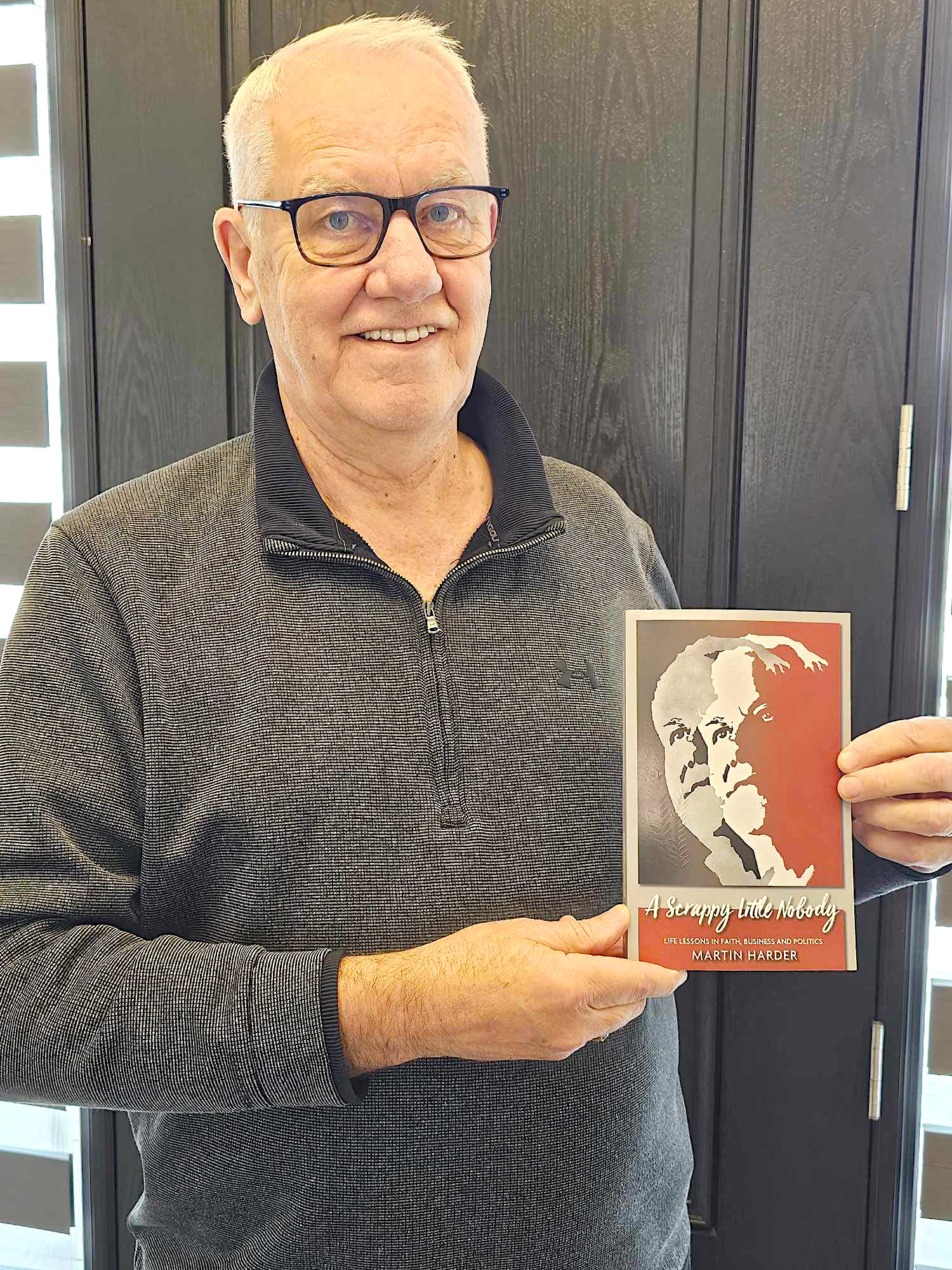
About 15 years ago, Les Kletke wrote a book for various people in the grain business, asking Martin to write a chapter, which birthed the idea of his book.
“In reality, the experiences in my life are many that I would say usually should never have happened, but yet things did happen,” said Harder. “I’d often find myself backed against the wall, trying to figure a way out, and that’s where the concept of being a scrappy little nobody originated.”
I had the privilege of reading the initial draft, and once I started, I couldn’t stop. Martin’s message about getting things done right resonated with me, and I immersed myself in his words until the end. Having known him personally and having written several articles about his work, it clicked into place. It gave me a new perspective on Martin Harder, the businessman, family, faith leader, and 16-year Mayor of Winkler.
“Perhaps that’s precisely what you intended,” I told him, “to provide clarity and insight through your writing. If so, mission accomplished!”
Martin told me that despite having a weak educational background, he hopes readers will understand that his book is not just a collection of my achievements, although there are many. It’s about the journey, the process itself.
What intrigues me most is looking back and seeing how that process unfolded, leading to the creation of this book. I felt compelled to write it down so that others going through their journeys, albeit in different circumstances, can relate to some of the stories.
“Another aspect I appreciate about the book is its structure. Each chapter represents a segment of my life, allowing readers to pick it up, read a chapter, and come back later to explore another segment,” he said.
It’s like Dizzy Dean said, you know, the all-star pitcher. It ain’t bragging if it’s true.
“Well, this is the story from my record, my reflections, my recollections, and my side of the story. It may not be somebody else’s side, but mine.”
Harder’s last comment: “The place that God has placed in my life has brought me through these circumstances. You can read the book if you’re not religious; you can still read it and get some value in it. However, when you see the hand of God, I hope that people will realize
the importance that God has placed in my life, and that’s my aim.”
On March 24, 1997, the Jordan Corner, where Provincial Roads 3 and 23 intersected, emerged as an ideal site for a grain elevator business.
Martin Harder, a seasoned grain elevator manager at Cargill Ltd. in Manitoba, made a significant move by purchasing the elevator owned by the Local Association of Manitoba Pool Elevators. Remarkably, since then, his operations under Delmar Commodities Ltd. have consistently avoided negative profit margins, surpassing Manitoba Pool’s grain movement in just seven or eight months compared to their previous year. Notably, a significant per cent of the grain handled—80 per cent—consisted of non-Canadian Wheat Board grain, primarily serving the local feed market.
Harder’s transition from Cargill to an independent phone broker in the grain business marked a shift toward legitimacy. He had long dismissed the role of phone brokers in the industry and sought an opportunity like this elevator acquisition to establish credibility. Reflecting on this move, Harder noted, “To be a phone broker tended not to give you legitimacy in the grain business.”
For seven years, Martin Harder drove past the Jordan Corner facility on his way to manage the Elm Creek facility for Cargill. Harder wasted no time when the opportunity finally arose to buy the Jordan Corner facility. He reached out to the executive of the MPE Association to inquire about the elevator’s availability for sale. Initially, the answer was no, as the association had a long-term agreement with Manitoba Pool to sell the facility. However, the executive discovered their standing in the pecking order with Manitoba Pool, likely realizing that Manitoba Pool intended to shut down the elevator within the next year due to falling grain volumes. After calling for tenders, Harder’s bid for 150 thousand dollars was successful. The rest they say ‘Is History’! Hence the book ‘The Scrappy Little Nobody.’ •