When you are a smaller scale producer and you want to direct market pork finding access to processing is increasingly a challenge.
In British Columbia the situation actually lead to the formation of an organization to help producers.
The Small-Scale Meat Producers Association represents British Columbia farmers and ranchers who are raising meat outside of the conventional system. It is a registered non-profit society made up of primary-producers as well as supportive individuals and organizations.
Organization Executive Director Julia Smith explained the SSMPA “was formed when a group of livestock producers in British Columbia realized they were unable to scale their farms despite strong consumer demand for local meat. The primary barrier was a lack of slaughter and meat processing capacity for small-scale producers.”
So producers came together to collectively seeks solutions.
“We came together to advocate for regulatory changes and practical solutions that would increase processing capacity and support the growth of small-scale meat production in the province,” said Smith.
SSMPA was incorporated as a non-profit society in 2018.
In 2022, the organization published the results of a province-wide survey of small-scale meat producers and received more than 700 responses.
“Based on those results, we estimate that we represent the interests of at least 7,000 small-scale meat producers across British Columbia,” said Smith.
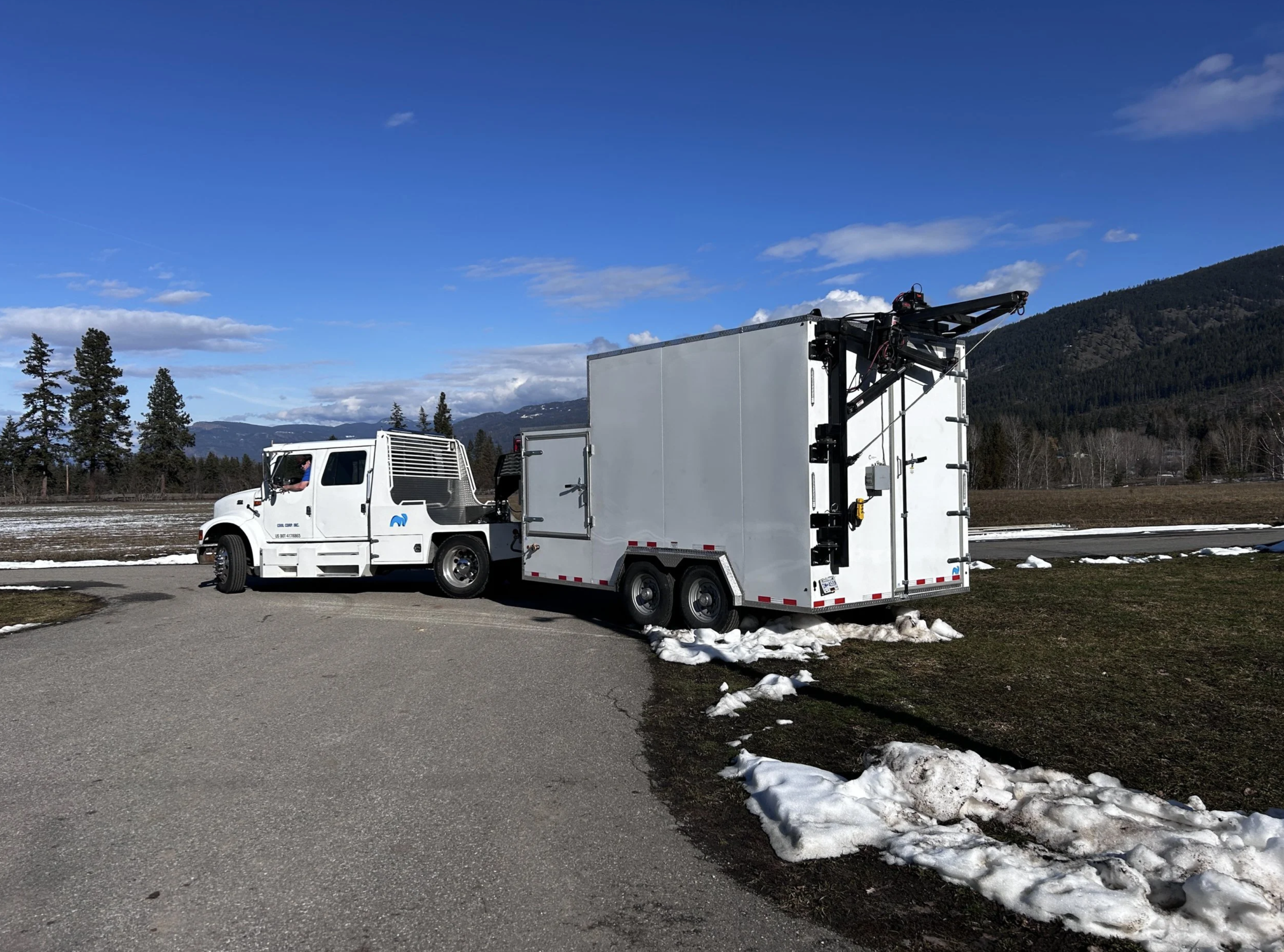
One of the initiatives undertaken is the Mobile Slaughter Trailer Project which builds on SSMPA’s existing work increasing meat processing capacity through mobile slaughter and delivering education and training.
“Our aim is to establish a coordinated emergency response network supported by a fleet of slaughter trailers and strategically located food hubs throughout the province,” details www.smallscalemeat.ca
“The project focuses on infrastructure through mobile slaughter trailers that can be deployed in emergencies to enable the humane depopulation of livestock. Where appropriate, these trailers can also support the safe harvesting of meat for further processing and community distribution.”
As an offshoot is the North Okanagan Butcher Hub which “is designed as a multi-species facility,” explained Smith. “At the moment, we are processing a significant number of pigs and cattle, but the facility is also equipped to process lamb and poultry. Demand varies by region and time of year, but the system was intentionally designed to serve a wide range of livestock producers.”
Developing a travelling processing unit wasn’t actually part of the original vision for the group.
“In the early years, SSMPA was primarily focused on regulatory reform,” explained Smith.
“But one of the key changes we helped achieve was an amendment to the Meat Inspection Regulation that allows small-scale producers to process up to 25 animal units per year on farm.”
An animal unit is roughly equivalent to one steer, four pigs, or 10 lambs.
“That means producers can process about 25 steers or roughly 100 hogs annually under this framework,” said Smith.
“Once that regulatory change was in place, it became clear that many producers either did not want to slaughter their own animals or did not feel they had the appropriate training to do so.
“That led to the idea of developing professional mobile slaughter infrastructure so trained slaughter personnel could travel to farms, humanely process animals on site, and then transport the carcasses to a licensed facility for further processing.”
Most of the funding for the North Okanagan Butcher Hub came from the Province of British Columbia through the Ministry of Jobs, Economic Development and Innovation, through the Community Economic Recovery Infrastructure Program.
The Township of Spallumcheen, which owns the land where the facility is located, also contributed significantly by covering many of the site preparation costs.
“In addition, contractors working with the Small-Scale Meat Producers Association contributed substantial in-kind labour and time to help bring the project to completion,” said Smith.
As might be expected there have been challenges with the project.
“Like many projects that span several years, one of the biggest challenges was staying within budget,” offered Smith. “The original budget was developed well before construction and manufacturing began, and costs increased significantly during that time.
“The project also required approval from the Agricultural Land Commission. The facility is located within British Columbia’s Agricultural Land Reserve, which protects farmland from non-agricultural development. Although abattoirs and meat processing facilities are permitted in the reserve, a non-farm use application was still required.”
“Working through that regulatory process, coordinating contractors, and managing construction timelines were all important parts of getting the project completed.”
Smith said the unit fills a well-identified need.
“Access to slaughter and cut-and-wrap capacity has consistently been identified as the single biggest barrier to growth for small-scale meat producers in British Columbia,” she said. “The North Okanagan Butcher Hub was developed specifically to help address that bottleneck by creating additional regional capacity and making professional processing services more accessible to producers.”
The actual facility includes a large walk-in cooler and walk-in freezer, along with the full range of equipment required for meat processing. That includes a band-saw, mixer-grinder, vacuum packaging equipment, and other tools used for cutting and wrapping meat.
“We will also be operating a slaughter trailer in the region which will travel to farms and ranches providing slaughter services. Those carcasses can then be brought back to the Butcher Hub for processing,” added Smith.
Producers can book animals for processing by contacting the facility directly by phone or email. The service is available to all producers in the region and is not limited to SSMPA members.
There is a cost to producers but Smith noted “the cost of slaughter and cut-and-wrap services is generally comparable to market rates for similar services elsewhere in the province.”
There are some things the producer must do too.
“When using the mobile slaughter service, producers are responsible for providing safe and functional livestock handling facilities on their farm,” explained Smith. “The slaughter trailer itself is self-contained.
“The team operating the unit provides trained slaughter personnel, water supply, fuel, and all necessary equipment required to process the animal safely and humanely.”
The unit is being well-used.
“The Butcher Hub has been operating since last fall and still has some capacity,” said Smith.
Demand for slaughter and processing services is seasonal, with the busiest period typically occurring in the fall when many producers finish livestock for market.
The slaughter trailer is due to start operating this spring.
Because the facility has only recently begun operations, Smith said it is still too early to provide firm annual numbers for producers by species.
“However, pigs and cattle are currently among the most common species being processed,” she said. •
— By Calvin Daniels