A hog marketing group based in Edmonton is asking producers across Canada to join together in developing a fair pricing system for their hogs.
Spearheaded by the Western Hog Exchange, a new partnership has been formed, the Fair Priced Pork Alliance, to update Western Canada’s pricing formula to something that is more equitable for Canadian producers and processors. Brent Bushell, WHE’s general manager, has made various representations in the past, speaking about pending doom in an industry whose primary producers often find themselves struggling with minimal or negative margins.
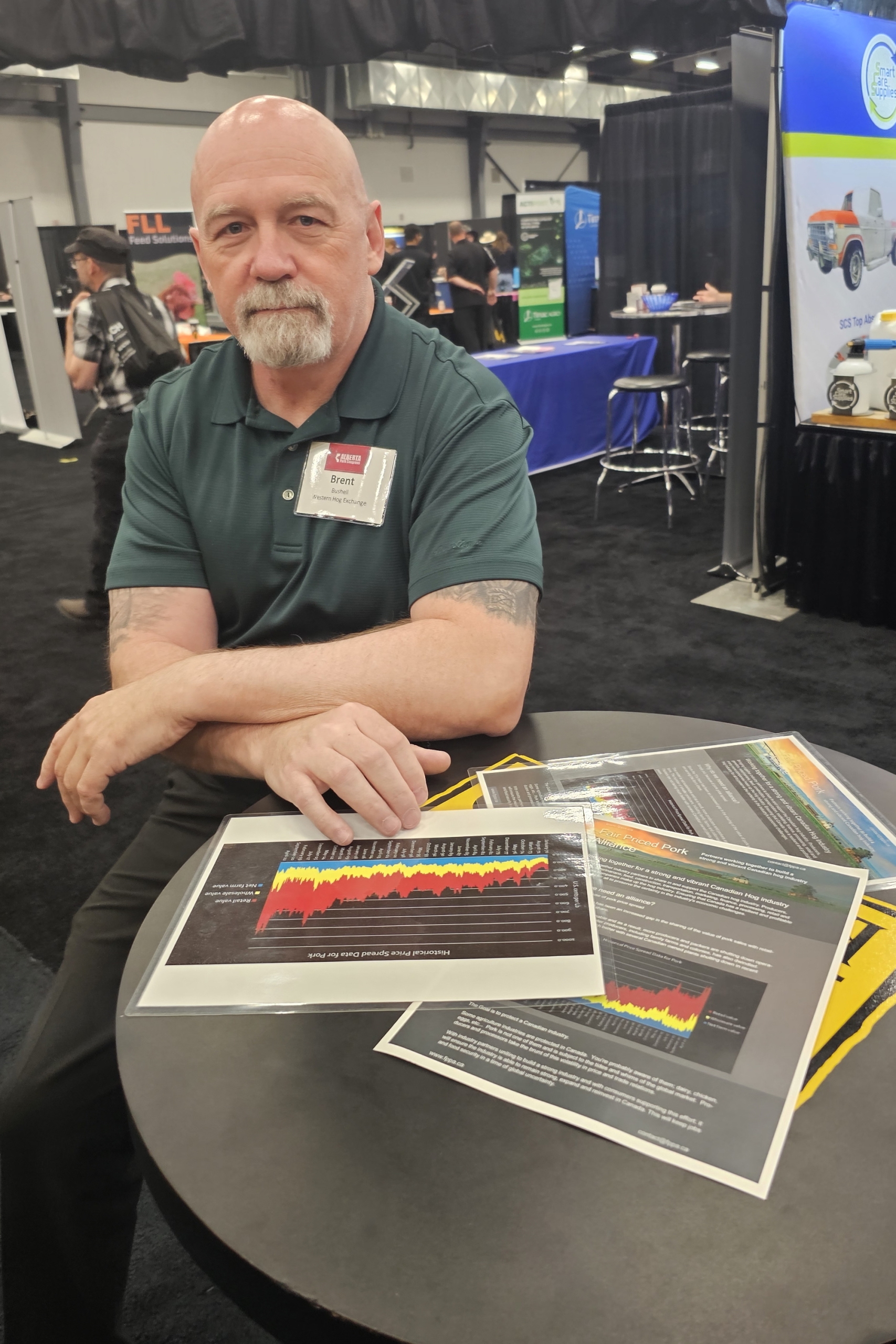
Bushell said in an interview with Prairie Hog Country in June that the new initiative has been created to address issues within the Canadian pork industry, starting with mandatory price reporting at the processing plants. Although spearheaded by WHE, the FPPA is not intended to affiliate with any specific group. Rather, it seeks to bring all producers and producer organizations together to address issues that affect profitability on the farms and in the plants, he said.
To that end, Alberta producers were invited to attend information meetings held in Nobleford on July 24 and Red Deer on July 25 and talk about building a pricing system that works.
Southern Alberta producer Andy Walter, who sits on the Alberta Pork Board and is also Alberta director for H@ms Marketing, told Prairie Hog Country that he was “very impressed” with what he learned at the Nobleford meeting. He attended along with Alberta Pork Chair Stan Vanessen and two other directors from Southern Alberta.
Walter said he had entered the meeting with some concern, because the group appeared to be focusing on domestic consumption and the retailers’ share of the total price. He felt that to be a problem because 70 per cent of pork produced in Canada is exported, while only 30 per cent stays in the country. So, there has been a great deal of discussion about the retail share being disproportionate to what packers and producers receive. At the same time, any attempt at creating a single-desk marketing system, such as those that exist in the dairy and poultry sectors, would imperil Canada’s agreements with international trading partners. Walter said he was worried that the lion’s share of income from export markets would be at risk in at attempt to extract a larger share of the profits from domestic consumption.
At the same time, Walter said he would like to find ways of encouraging Canadian consumers to buy Canadian pork, assuming that roughly 20 per cent of the pork on shelves in Canada comes from outside the country. It has been shown that consumer preferences come down to price when they’re shopping to feed their families, he said. For example, ham from hogs raised without antibiotics will not sell if they are offered at a premium price.
FPPA’s proposal for mandatory price reporting from all processors would help build a pricing system that would ensure producers and processors each get a fair share of the cut-out without asking retailers to give up a share of their profits, said Walter.
He feels confident after sitting through the meeting in the direction taken by the new alliance, which will need support from producers and producer groups, including provincial pork boards and the Canadian Pork Council.
Bushell said CPC is also working on a mandatory price reporting model. WHE contributes $1 per hog and other groups will have to kick in as well to help ensure the financial viability of the new alliance, said Walter. He intends to encourage H@ms to collaborate in the effort, on behalf of the producers it serves.
Bushell has said repeatedly that Canadian processors need to be on board with a fair pricing system if they wish to remain competitive and have a secure source of hogs to fill their rails. He said mandatory price reporting is essential to prevent market disruptions and protect farm incomes.
For example, Olymel’s decision to cut back on processing in Quebec had a ripple effect in Ontario, whose producers were forced to seek other markets for their hogs, he said.
“What they did initially is, they started shipping them into the United States as market hogs, because they had to move them through the system. But now, a lot of those guys in Ontario have said, we’re going to do one of three things: We’re going to keep going, which is obviously one election, but two, we’re going to pull the pin and shut down our barn or, three, we’re going to convert our operation . . . to iso-wean. So what does that do for our province?”
Once those barns convert to shipping iso-weans into the US, the door will close on any opportunities for new processing in Ontario because the supply of finished hogs will have dried up, said Bushell. Each province has its own story to tell, but the bottom line is that producers, processors and retailers all need to earn a fair share to stop the bleeding, he said.
“The point is, we all live in this nightmare, so are we prepared to work together?”
“Everybody’s dealing with a demon for different reasons, but it takes us to the same end goal, so I don’t think there’s ever, in my opinion, been a better time when this industry could rally under a unified voice.”
The FPPA was formed last November and introduced publicly during Alberta Pork Congress in June. Bushell said a website has been created. It is still quite simple but will improve as support grows for the initiative. Please visit www.fppa.ca or email contact@fppa.ca for further information. •
— By Brenda Kossowan