If producers took home only one message from Alberta Pork regional meetings held in Mid-March, it likely relates to a slide Chair Brent Moen used to demonstrate how pork value is shared.
Pictured on this page is the slide Moen offered, showing how the retailers’ share of pork value has risen continually while the producer and processor shares remain relatively stagnant.
“It should be a billboard,” Moen said after his presentation to producers in Red Deer on March 14.
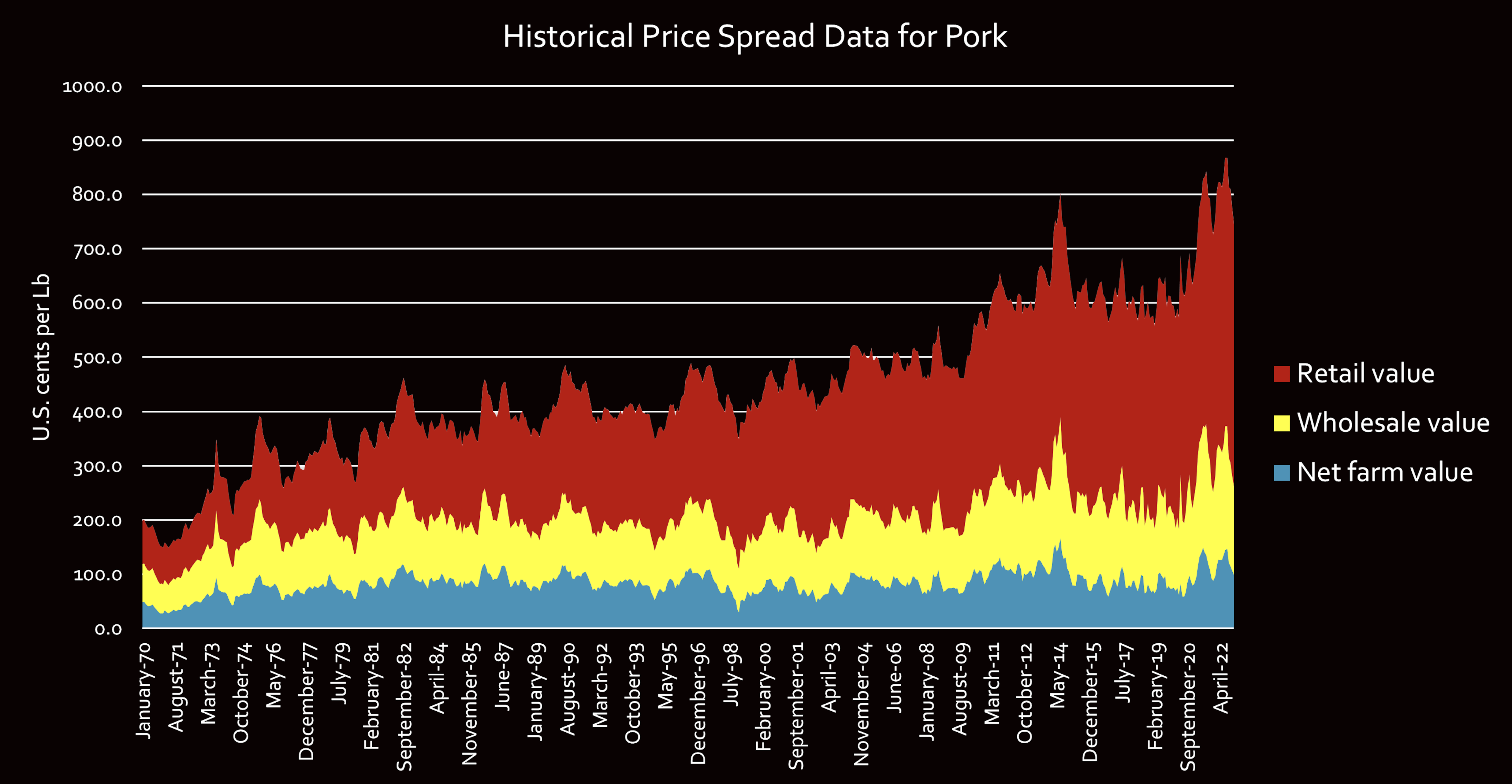
During his talk, he explained that the graph shows why wholesale price discovery is so important to pork producers.
“It’s a great visual of what’s going on, right?”
Figures used to compile the data show that in January of 1970, producers in the United States were getting just under one third of the retail price at $2.00 US per pound. The share remaining for processors and retailers was evenly split. By April of last year, retail pork had reached an average of $7. Producers were still receiving about $1.50 while retailers raked in $3.50 leaving the balance to processors.
While prices overall had slipped somewhat when the graph was compiled, the split remained the same with retailers seeing half of the total value for pork sold.
In his overview, Moen described the pressures and uncertainty challenging producers and processors while retailers remain profitable.
Late in February, Canadian grocery giant Loblaw, owned by the Weston Family, reported that it had earned profits of $529 million, an increase of just under 13 per cent, while Canadian families and the producers who grow their groceries continue their struggle with inflation.
Yet, in his submission to a Parliamentary committee early in March, Loblaw Companies CEO Galen Weston stated that Canada’s largest grocer is earning only about $1 for every $25 bag of groceries.
Producers and processors, in the meantime, are fighting off negative margins brought on by labour shortages and high input costs, especially for feed.
“That’s why price transparency is so important, so that we can actually sit down with politicians, with consumers, and say: ‘Is this part of the problem? Absolutely it’s part of the problem,’” said Moen.
“So, things to watch for: Margins could continue to be eroded by high input costs; we need a price that recognizes and compensates for escalating global costs in the potential of an ASF (African swine fever) outbreak in North America; it’s imperative that Canadian processing plants fill their labour shortages and move products into export markets at maximum cutout value.”
Moen had said earlier that, because of labour shortages, processing plants have been forced out of taking high-value cuts that achieve maximum pricing in the marketplace.
Compared with their counterparts in the United States, Canadian producers remain at a competitive disadvantage, said Moen. He showed one calculation that estimated average profit margins in Canada at $10.71 per animal compared with $24.46 in the US.
Canadian processors continue to wallow in red ink.
“Olymel had a terrible year last year; it was tough on them. They lost $445 million. In 2021 they lost $71.8 million and in 2020 they made $215 million,” said Moen.
“All kinds of challenges led up to that number. We need, as producers, to make sure that our processors are viable and are making money for the health of our industry in the long term.”
Moen then described how Maple Leaf, while faced with the same challenges as Olymel, has reinvested profit into making plant-based proteins that they will sell at a loss against the products that are earning profits.
Maple Leaf has stated its objectives in its annual report.
“But I don’t work for Maple Leaf, so I can’t figure it out.”
Moen advised producers to watch for continual erosion of margins through high input costs. Prices to producers need to compensate for escalating costs associated with protection against ASF and preparation for an outbreak in North America. Canadian plants must be able to resolve labour shortages and move products to export at maximum cutout value.
“We also need to make prudent risk management decisions . . . because it’s a volatile marketplace.”
Given ASF impacts in China and Europe, there is a possibility of strong prices to come, said Moen. The downside, however, is that input costs may rise as well.
“There is a lot of room for optimism and things are moving forward, I think. Producers should still consider contracting options for inputs and hogs, if they see that it’s good value for them,” he said.
A Lacombe-area producer in attendance at the Red Deer meeting suggested that money should be made available to help producers fence their properties as an additional line of defense against feral pigs.
Veterinarian Kurt Preugschas responded that fencing is prudent in areas where ASF is suspected. In the event ASF is found in Canada, the repercussions will be tough, at least in the short term and depending on agreements with countries that import Canadian pork, said Preugschas.
“I don’t know what that short-term means. It really comes down to agreements with different countries and where that outbreak occurs.”
The concept of fencing is logical in the event that an outbreak is found among the wild pigs because effective fencing would reduce the risk to farms, said Preugschas.

Executive director Darcy Fitzgerald updated producers on ASF prevention and preparedness during his presentation.
“We are working on plans and our packers are working on plans to have humane cull lines if we have to. We definitely don’t want a situation like they had in the (United Kingdom) when they had foot and mouth disease. We want it to be orderly, we want you to understand what could be there, if something happens to be calm, patient and wait; the banks to be calm, patient and wait; the feed guys with your bills to be calm, patient and wait. Because otherwise, it will just be a crazy show, and we don’t need that,” said Fitzgerald.
Potential burial sites, euthanasia practices and other additional responses are being considered in preparation for an outbreak, he said.
“We have a lot of stuff that we’ve been working on with the government and with the Chief Provincial Vet to make sure that we have stuff available to help out where it needs to go.”
Contractors continue trapping in the places where wild boars have been sighted and the province is helping with disease surveillance. All feral pigs caught are tested for disease at the provincial laboratory.
Buyers want to see that the programs and protocols are in place as described. They want to see that there is an overarching program in place that does what is purports to do, said Fitzgerald.
There are currently more than 1,000 producers registered throughout the province, of whom fewer than 300 are commercial farms, he said. The onus is on all producers, including small producers delivering to provincially inspected abattoirs or selling live pigs to their neighbours, to perform their due diligence in terms of biosecurity and traceability, he said. Additionally, those producers must be diligent in doing the paperwork to show they are conducting their business in step with biosecurity and traceability protocols.
Strict adherence to those measures can provide assurance to buyers who may be willing to accept compartmentalization and zoning protocols in the wake of a disease outbreak, said Fitzgerald.
Regional meetings wrapped up with information updates from Jody Wacowich of AgSafe Alberta and Lisa Nadeau from the Alberta Environmental Farm Plan.
Wacowich advised producers of the safety and educational tools available to them and the regulations that apply on their farms and in their production facilities.
Besides providing assurance that farmers do not have a looming disaster on their sites, the EFP is required for anyone who has applied for grant money through the Canadian Agricultural Partnership program, which is currently under revision, said Nadeau.
The workbooks have been replaced by an online application, with help available at no charge through her office. Visit for details.
Wacowich spoke about expectations and obligations under provincial regulations and pertaining to Workers’ Compensation Board requirements.
She described the most common types of fatalities on farms and showed statistics demonstrating who is most likely to suffer a fatal or time-loss injury.
In 2021, 11 on-farm fatalities were reported. All the victims were male and they were all over 50 years old.
Wacowich pleaded with producers to review their safety protocols and seek advice on how they can prevent injuries.
“If you don’t want to do it for yourself, do it for your employees and do it for your families, because they want you to come home tonight,” she said.
Visit to learn more about how you can assess your farm and keep your people safe.
Alberta Pork regional meetings are held annually, midway through the fiscal year, to update producers on developments within their industry. Staff and directors have also resolved to hold meetings with smaller groups to discuss issues that may affect their operations.
Visit or call 780-474-8288 for details. •
— By Brenda Kossowan