
Lineups for morning coffee, people perched in windowsills, a cacophony of enthusiastic chatter: These are the signs of new energy within a community of people who have been through the mill together, in isolation.
The return to a full-contact Banff Pork Seminar opened on Tuesday, January 10 with 750 delegates registered and a stream of walk-ins bringing the total number of registered attendees to 783 by closing time on January 12. That’s in contrast to the 2022 edition, a hybrid version held online and in person when COVID restrictions were still in place and on the heels of local outbreaks. Fewer than 200 people attended the in-person meetings in 2022, generating a tangible air of emptiness.
The ambience in 2023, by contrast, was of enthusiasm and high energy which delegates and organizers suggested could be attributed to optimism in the industry or the ability to get back together in person or a combination of both.
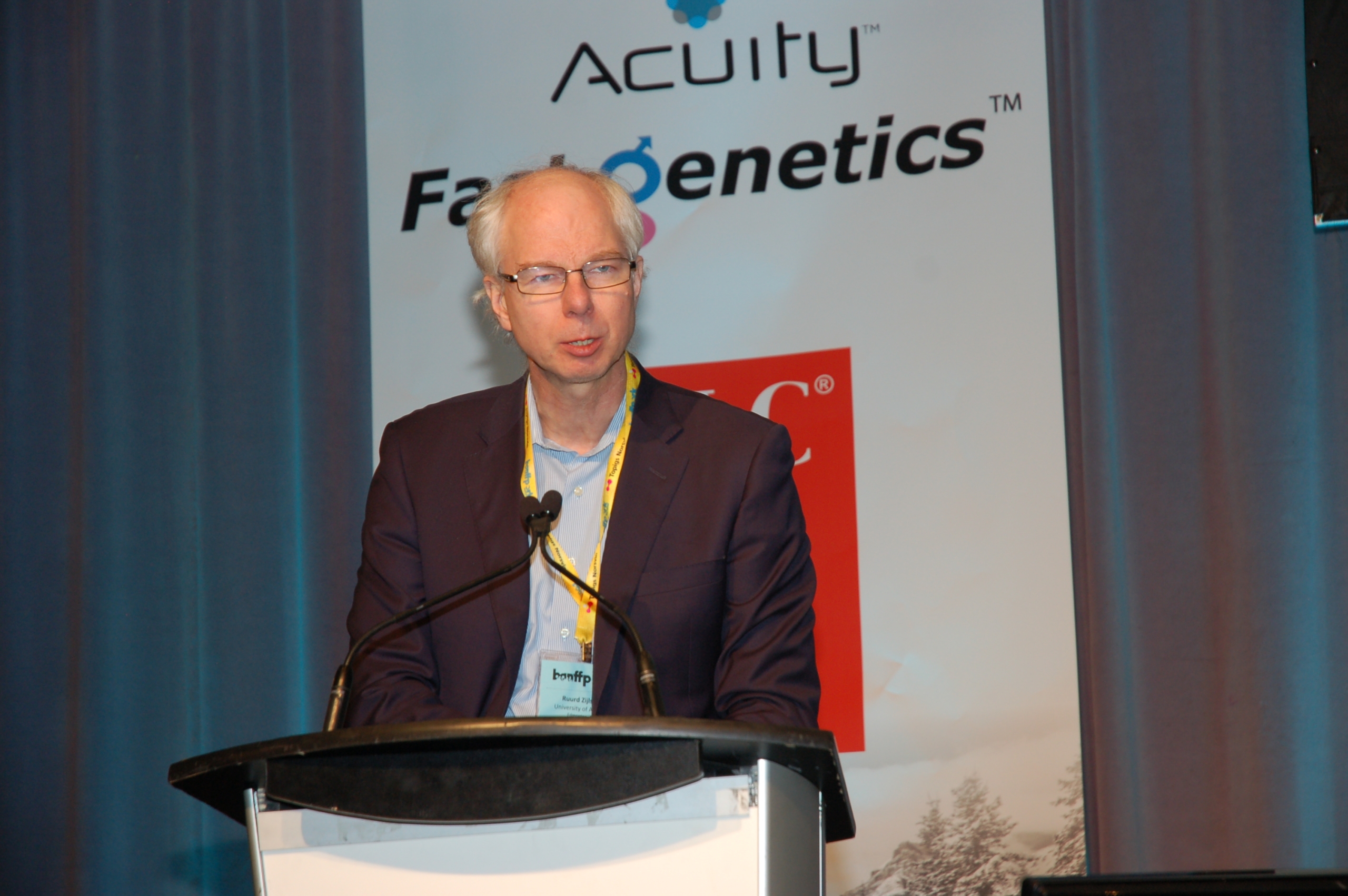
“By golly, what a difference a year makes,” said Ruurd Zijlstra, program co-chair and a professor in the Department of Agriculture, Food and Nutrition at the University of Alberta in Edmonton during his closing remarks to those delegates who remained for the last speaker.
“Our objective is to have a relevant program. Part of our mandate is to have education, and the other part is to have networking opportunities, and when I look at crowds like we had here this week, of course we had an awful lot of wonderful networking opportunities,” he said.
Zijlstra’s partner in the conference, co-chair Michael Dyck – an associate professor at the U of A, expanded on the networking component. Dyck said speakers and delegates learn from each other and often develop long-lasting relationships in areas of mutual interest. Breakout sessions open discussion, but that discussion carries on after the sessions close, said Dyck.
“Yes, it’s hard to get all that information (in). If we’ve got an area that we want to explore, whether it’s housing or feeding or whatever, if we can talk about the scientific background in a couple of talks, and then have a producer or manager come in and talk about what they’re doing in their system, . . . it shows that they’re taking this information and applying it the best they can within their environment.
“That creates a whole other discussion where other people who want to apply the same technology and the same approach speak to those managers and producers and give them ideas as well, so it’s not just one way.”
BPS also brings opportunities for supporters to hold meetings and to introduce new players in the industry.
Among those new players is Stephen Heckbert of Ottawa, who was named executive director of the Canadian Pork Council early in December.
Heckbert comes to the pork industry from Algonquin College, where he led the public relations program.
“We were really focused on bringing practical, simple communications tools. If I can speak for the board, I think that’s one of the things that appealed to them, because I think communications is a challenge for everyone at this moment,” Heckbert said in an interview with Prairie Hog Country.
He said the board of directors stepped up in the absence of an ED, but he is now prepared to fill that role.
“I’m not trying to become an expert on everything in the industry, but I am trying to make sure that the team that we have, who are experts, have the chance to do their best work, and it’s my job to facilitate that.”
He said he has started by embarking on a national tour and plans to meet as many farmers as possible. Part of his role will be to help farmers tell their story in a way that can be understood and appreciated by consumers.
“If our story as producers isn’t easy to explain or easy to absorb for someone else, it will be tough to make sure that our message is getting through.”
Heckbert said his goal is to simplify how producers communicate with industry, government and other important players.
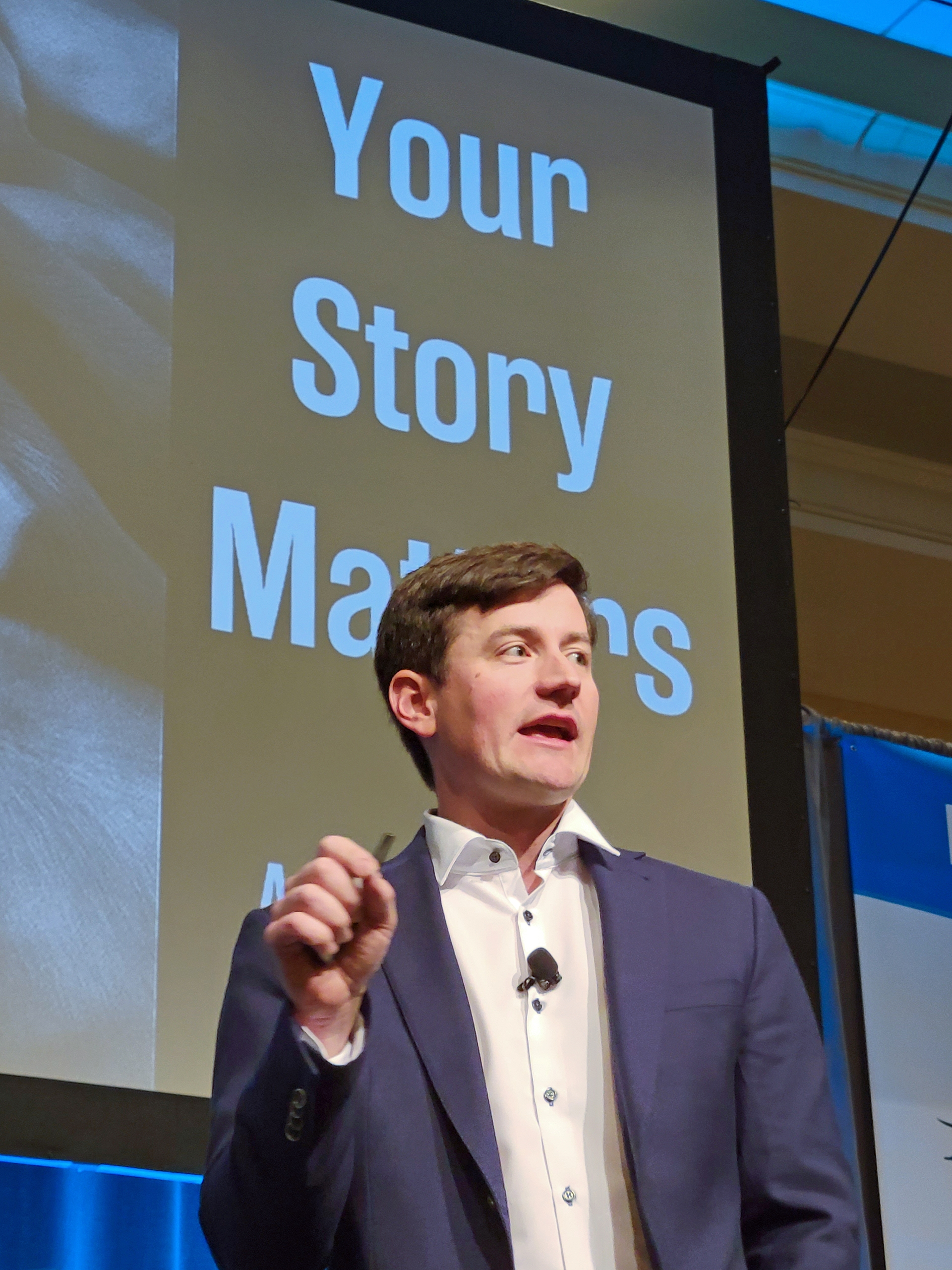
BPS delegates have been hearing repeated messaging about the need for them to tell their story, including a talk at the final session on January 12 by “Fresh Air Farmer” Andrew Campbell, whose family farm includes a dairy and mixed crops in Middlesex County in Southern Ontario.
Under fire during the question-and-answer period, Campbell found himself facing a young woman from Guelph who asked how farmers are supposed to tell their story when they’re busy caring for their animals and seeking the best ways to improve their production strategies.
“Totally fair,” said Campbell.
“The time balance is one of the hardest things about doing that. But honestly, the thing that drives me and drives a lot of people that are already doing it goes back to the point that, if you don’t have a market, what does it matter what mortality rates are? Or if a processor says, ‘This is how you shall do it or find somebody else to buy pigs,’ then what does it matter what you learned? It is not easy … but if you’re waiting for someone else to do it, the processors won’t, the retailers won’t, government won’t. It’s our job.”
He said there are events and opportunities in which producers can participate to showcase their work and their progress in animal care and environmental stewardship.
Heckbert said consumers want to support local farmers, so it’s crucial that CPC talks about supporting local farmers without putting them in a situation where they are not cost competitive with farmers in other places where the same high standards are not imposed.
“The other thing is, we get very defensive without understanding all of the positives we already have but aren’t talking about,” said Heckbert.
“I refuse to believe that anyone cares more about their animals than a farmer. I think sometimes we lose sight of the fact that we can be more proactive in how we talk about the care we have for our animals.”
THE CONFERENCE
Wrapped around a theme of sustainability, the BPS 2023 brought speakers in to address overarching topics including social license, economic outlooks, foreign animal disease and genetic advancements. A plenary session on the first morning put Brett Stuart from AgriTrends and Steve Weiss from NutriQuest on the podium to talk about trends in global economics and food production. Some of their observations are noted in other articles within this edition of Prairie Hog Country.
The next morning, Banks Baker from PIC and Mauricio Alanis from Maple Leaf Foods spoke about the attitudes and adjustments adopted at their respective firms to ensure sustainability across the spectrum, including profitability, environmental stewardship, animal care and food security.
Director of new product marketing for PIC, Baker addressed sustainable food production.
Baker said protein production is facing challenges in areas including animal health and welfare, antimicrobial stewardship, food affordability and availability and climate action.
“Look at this as foreshadowing. What does this mean that we need to do to ensure that our customers . . . continually feel comfortable with consuming animal protein.”
Corporations committed to meeting greenhouse gas targets set under the Paris agreement now represent a “staggering” share of global markets, said Baker.
“As of last month, 83 per cent of Fortune 500 companies have climate targets, and that’s pretty significant, too,” he said.
Genetics play a significant role in allowing pork production to meet targets set within this environment where major purchasers have committed to The Science Based Targets initiative (SBTi) or a similar protocol. SBTi is a partnership between CDP (Carbon Disclosure Project), World Resources Institute, the World Wide Fund for Nature and the United Nations Global Compact.
“This is an important opportunity for us to make sure that genetic improvement is being accounted for and regulated properly,” said Baker.
He assured delegates that consumers will understand and respect the difference between gene editing and genetically modified organisms.
“So, how do pork producers benefit here? Our customers’ customers are asking for this. Our governments are compelling it. By removing carbon from our production chains, we’re making them more profitable. We’re making them more efficient. We’re actually doing more with less,” said Baker.
Purchasing carbon credits is part of Maple Leaf’s program to reduce its carbon footprint overall, said Alanis, director of sustainability strategy and partnerships for the company. He stated that, in 2019, Maple Leaf was the first company in the world to become carbon neutral.
“If we’re invested in capital projects that reduce our overall emissions by X amount, we’re able to say that X amount of emissions reduction is worth something to us, because we will not need to buy that many more emissions offsets later on.”
“We are committed to investing in carbon offset projects around the communities where we operate today.”
Those projects include wind energy and manure digesters, with a move to more nature-based projects such as regenerative agriculture.
“Today, we recycle 100 per cent of our manure. It’s a great way to maintain that circularity in our system and return those nutrients back to the lands,” said Alanis.
Delegates got a chance after the morning plenary sessions to drill deeper into production technology through a series of breakout sessions held on the first day and repeated on the second day.
Session 1 focused on Swine Health, with veterinarian Ryan Tenbergen looking at the past and future of circovirus followed by veterinarian Brooke Smith’s perspective on streptococcus suis and e. coli bacteria in the nursery. Session 2, Sow Management and Reproduction, introduced veterinarian Casey Neill and geneticist Kyla Ripley for their insight on best practices in feeding and artificial insemination. Down the hall in Session 3, David Speller from OPTIFarm and David Rosero from The Hanor Company looked at digital technology relevant to swine production.
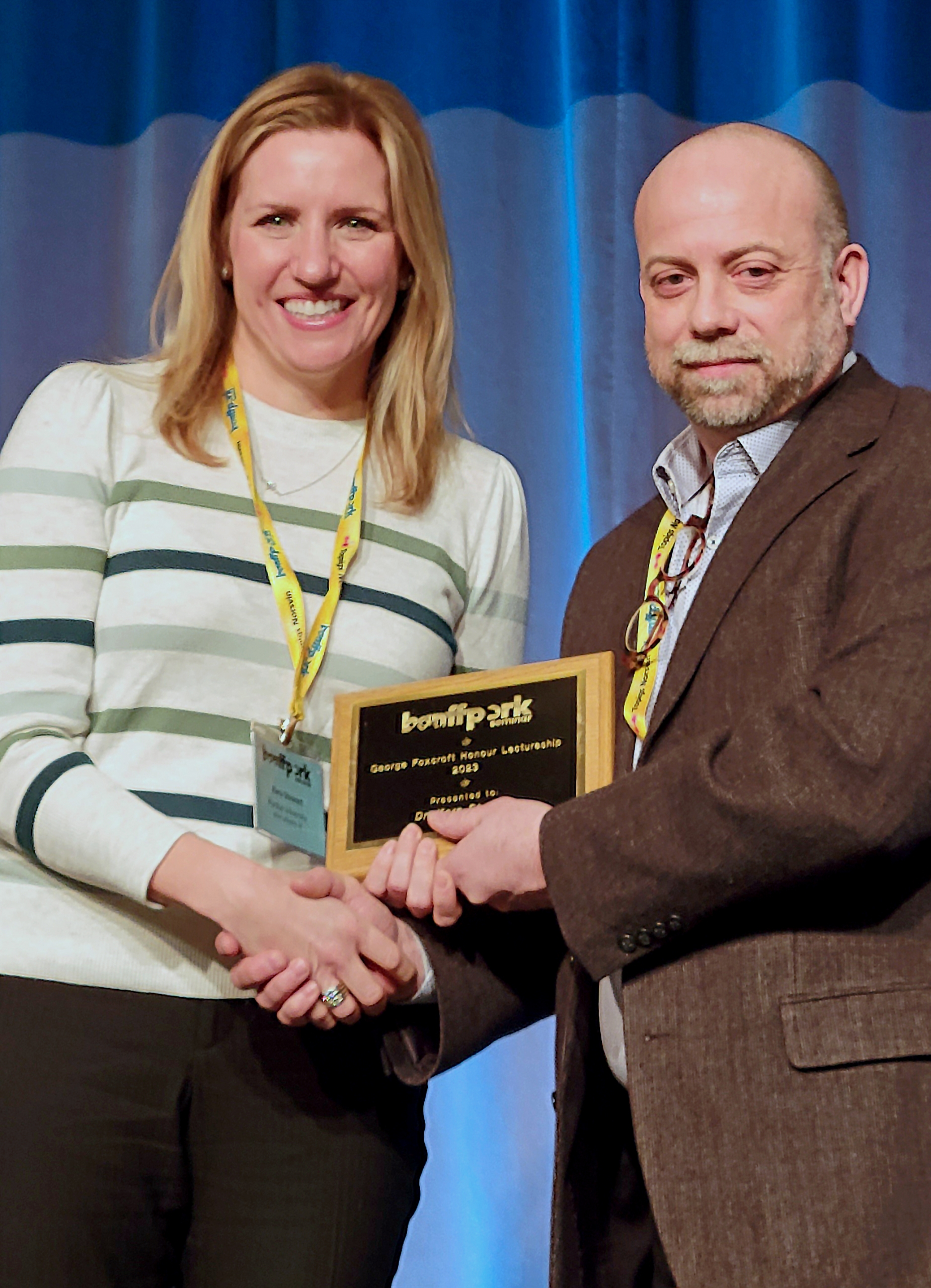
Afternoon breakouts included Session 5 on piglet management, led by Foxcroft Lecturer Kara Stewart, who has a PhD in Animal Science and is now a faculty member at Purdue University, where she earned her bachelor’s degree. Stewart shared her knowledge of colostrum management and piglet survival, followed by Lee Schultz from Iowa State University and John Sonderman from DNA genetics, who looked at economics of mortality and the effects of fostering strategies on piglet performance.
Session 6 drew delegates interested in grow-finish management to hear from speakers Matt Ritter from Cargill, Nat Stas from PIC and Kurt Stoess from HyLife on topics including late finishers, wean-finish efficiencies and optimizing feed costs.
Session 7, Feed and Nutrition, introduced a cast of star nutritionists including Francesc Molist, Malachy Young and Laura Greiner. The final session, Building Engineering, featured Stephen Clarke, Sebastien Fournel and Stéphane Godbout talking about energy savings, the future of pig housing and manure management.
Dyck said the BPS committee likes to focus discussion from time to time on advances in swine genetics, especially given the support received from genetics companies.
“We really appreciate that and I think part of the reason why they support us is, they come, they meet with their clients, they can do a lot more here. They also do a lot of good research, so every two to three years, we like to get some of their research on the program,” said Dyck.
“(Genetics research) is a key component of this program, that Ruurd and I have really tried to make sure is consistent, that we have a certain aspect of the program, particularly in the breakouts, where we’ve got some practical information that producers can take home.”

AWARDS
A highlight of BPS every year is presentation of annual awards, including the George Foxcroft Lectureship, the F.X. Aherne Award for Innovation and the R.O. Ball Young Scientists Grad Student Competition. As mentioned above, Kara Stewart was presented with the George Foxcroft Lectureship, recognizing her work on the effects of heat stress on sows and boars and the role of colostrum in piglet survival.
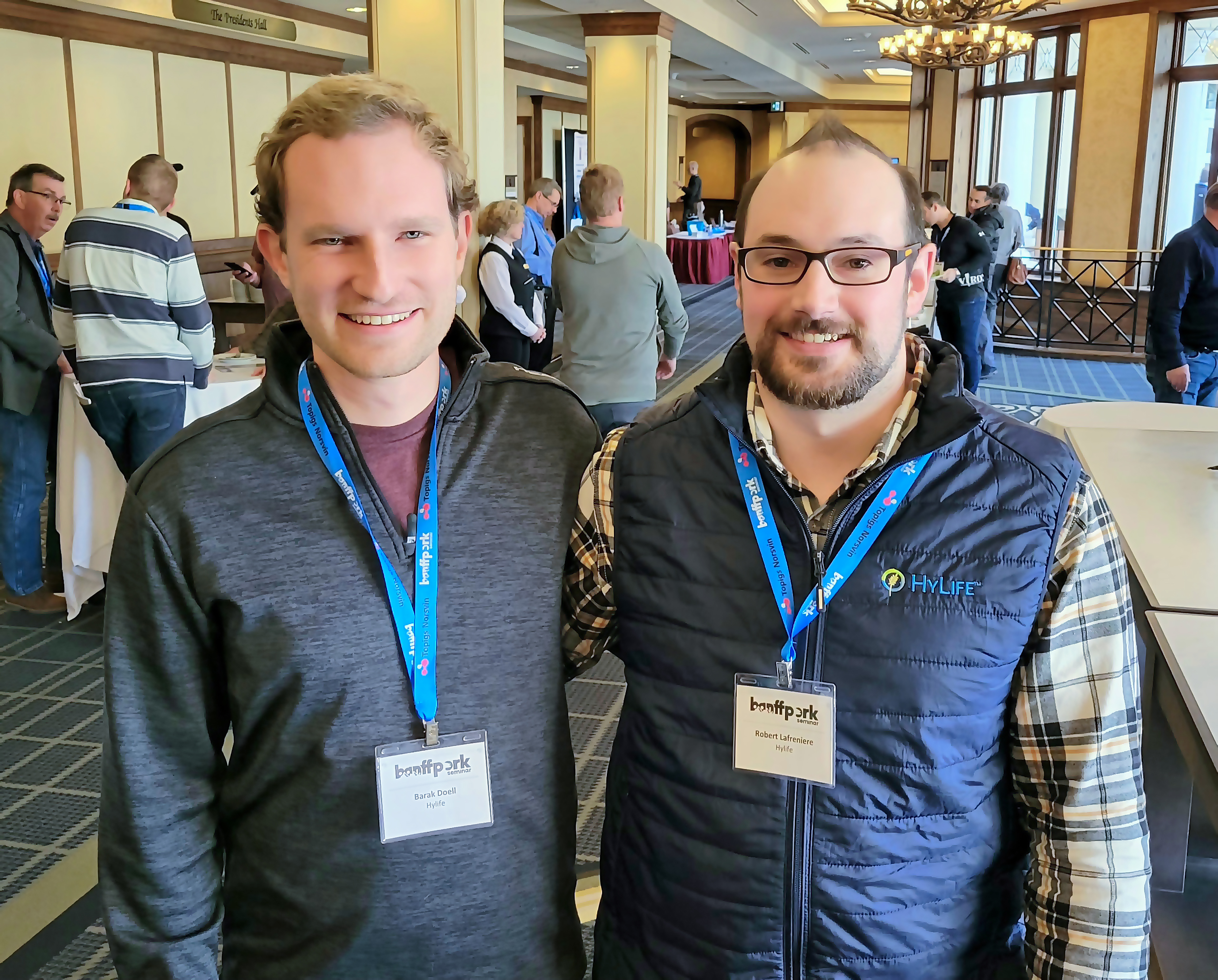
Two engineers from HyLife were named winners of the F.X. Aherne award, recognizing their invention of a ramp system for processing piglets.
Barak Doell and Robert Lafreniere were looking for a system that would lighten some of the stresses experienced while weaning, sorting and vaccinating piglets. Developed over three years, the Weaning Ramp lets the piglets run up to the handlers on their own steam, where they can be safely held for vaccination and then moved along to a slide that takes them down to their correct group. Doell remarked during their presentation that the piglets appear to enjoy the slide.
“You can see the smiles on their faces,” said Doell.
And what speaks more about the value of an invention than an endorsement from North America’s ground-breaking animal behaviourist, Temple Grandin, who is noted for driving much of the animal welfare improvements now installed on farms and in processing facilities.
The HyLife crew provided the following statement from Grandin: “This innovative system should be in every sow farm for vaccinating weaned piglets . . . I can’t say enough good things about it.”
In another statement provided by HyLife, Grandin goes on to say that the Weaning Ramp solves the backbreaking work of picking up piglets and therefore makes the job easier.
Doell and Lafreniere are members of the company’s Continuous Improvement Team, which is dedicated to solving challenges while improving animal welfare. They were presented with a pair of matching jackets at the opening of the Thursday morning plenary session.
First and second place in the R.O. Ball Competition, including cash awards of $500 and $250 respectively, were presented to Jessica Vehof from the University of Saskatchewan and Tausha Prisnee from U of A.
The choice was exceptionally difficult this year because all four finalists did an outstanding job at the podium, said Dyck, who was one of the five judges. The judges had previously chosen the finalists from a poster competition outlining various research projects in which they had taken part. The deciding point between first and second place came down to a decision about which of the two projects was most relevant to producers, said Dyck.
Vehof, working under supervision of animal behaviourist Jennifer Brown, took first place for her presentation on the effects of mixing practices in sow groups.
The team’s main objective was to generate knowledge on the effects of dynamic group housing on sow production.
Specific objectives were to compare the behaviour of sows in static and dynamic groups and assess the impact of sow aggression and injury; compare effects of early and late mixing on measures of reproduction, and study behavioural differences between dominant and subordinate sows in static and dynamic groups.
Sows were divided into three treatment groups, including a control group of sows housed in stalls after insemination for four weeks and then moved to static groups.
Second was a static group in which sows were put together from one to eight days after insemination and third was a dynamic group with eight to 10 sows replaced every four weeks.
Over the course of a year, data collected from the three groups indicated that the dynamic group outperformed the rest, with better farrowing rates and reduced aggression overall. Interestingly, the dynamic group had fewer total born, but also had the fewest stillborns and mummies.
Vehof said those data support use of a dynamic mixing treatment for the best possible sow performance in a loose-housing gestation room.
Interviewed after the competition, Prisnee said she and her team worked on the effects of a specific yeast, Kazachstania slooffiae, on immune function. K. slooffiae is among the yeasts that normally populate a pig’s intestines, but its role is not well understood, said Prisnee, who is working under supervision of Ben Willing, assistant professor in microbiology at the U of A’s Department of Agriculture, Food and Nutrition.
Her team wanted to determine whether feeding K. slooffiae could improve immune response and promote an anaerobic environment in the gut.
The team conducted its research with the objectives of determining the role K. slooffiae plays in immune system development during early life. They wanted to determine how early life colonization with K. slooffiae alters the bacterial community in the intestine and determine the impact of K. slooffiae on host immune system development.
Data gathered through their study confirmed that the yeast promotes an anaerobic environment in the gut, alters immune system development, promotes an inflammatory response to potential pathogens such as e. coli and warrants investigation as a potential probiotic organism.
“We wanted to look at K. slooffiae because it’s an area where there hasn’t been a lot of research, even though it’s very common in pigs and it’s very unique,” said Prisnee.
“Yeast species have long been fed to pigs for a variety of reasons, but they’re all ones that don’t naturally inhabit the pig, so we wanted to look at one that colonized and is there all on its own,” she said.
“Right now, it’s still too early to tell what it actually will do on a production front.”
The team is considering a survey that will look at different health outcomes.
Prisnee credits her participation in Toastmasters for providing her with the skills and confidence to create an effective presentation.
Banff Pork Seminar is a project of the University of Alberta, Alberta Agriculture and Forestry and Alberta Pork, managed by a committee of volunteers.
Zijlstra closed the 2023 seminar with a plea for new people to step forward and replace those who have stepped down. There is room for three or four new faces around the table, said Zijlstra. He thanked outgoing committee members, including chair Dan Bussieres and offered special thanks to conference coordinator Ashley Steeple and her team for their many hours of hard work.
Zijlstra then recognized the 57 sponsors whose total contribution was $144,000. That amounts to $184 per registered attendee, said Zijlstra.
Please visit to view proceedings and notes from the seminar. New this year, conference delegates will have access to recordings of the meetings. All registered delegates were to receive an email notice once the recordings were posted.
Banff Pork 2024 is set for January 9-11 at the Fairmont Banff Springs. •
— Bt Brenda Kossowan