
For decades, fibre in pig diets has largely been viewed as a constraint — something that dilutes energy, reduces digestibility, and is managed rather than optimized. However, the push toward more sustainable and cost-effective feed ingredients has made higher-fibre diets increasingly common in pork production. This shift has expanded our understanding of fibre; its components, functionality, and role in swine diets.
While further research is still needed to fully unlock the potential of fibre-rich ingredients, the perception of fibre as a negative is clearly evolving. Advances in our understanding of its functional properties, particularly its effects on gut health, microbial fermentation, nutrient utilization, and even animal welfare, are opening new opportunities to improve both performance and resilience in modern production systems. Rather than simply filling space in the diet, fibre is emerging as a strategic tool that, when selected and managed correctly, can support healthier pigs and more efficient production.
What Is Fibre, Where Does It
Come From?
Macronutrients make up the majority of nutrients in all animal diets and include carbohydrates, protein, and fat. Carbohydrates, the primary energy source, can be further classified into sugars, starches, disaccharides, oligosaccharides, and non-starch polysaccharides (NSPs). NSPs, commonly referred to as dietary fibre, cannot be digested directly by the animal, as the enzymes required to break them down are not produced in the gastrointestinal tract.
In monogastric animals such as pigs, these fibre components pass undigested through the stomach and small intestine, before entering the large intestine. Here, they are fermented by the resident microbiota, producing volatile fatty acids (VFAs), which can then be absorbed and used as an energy source by the animal.
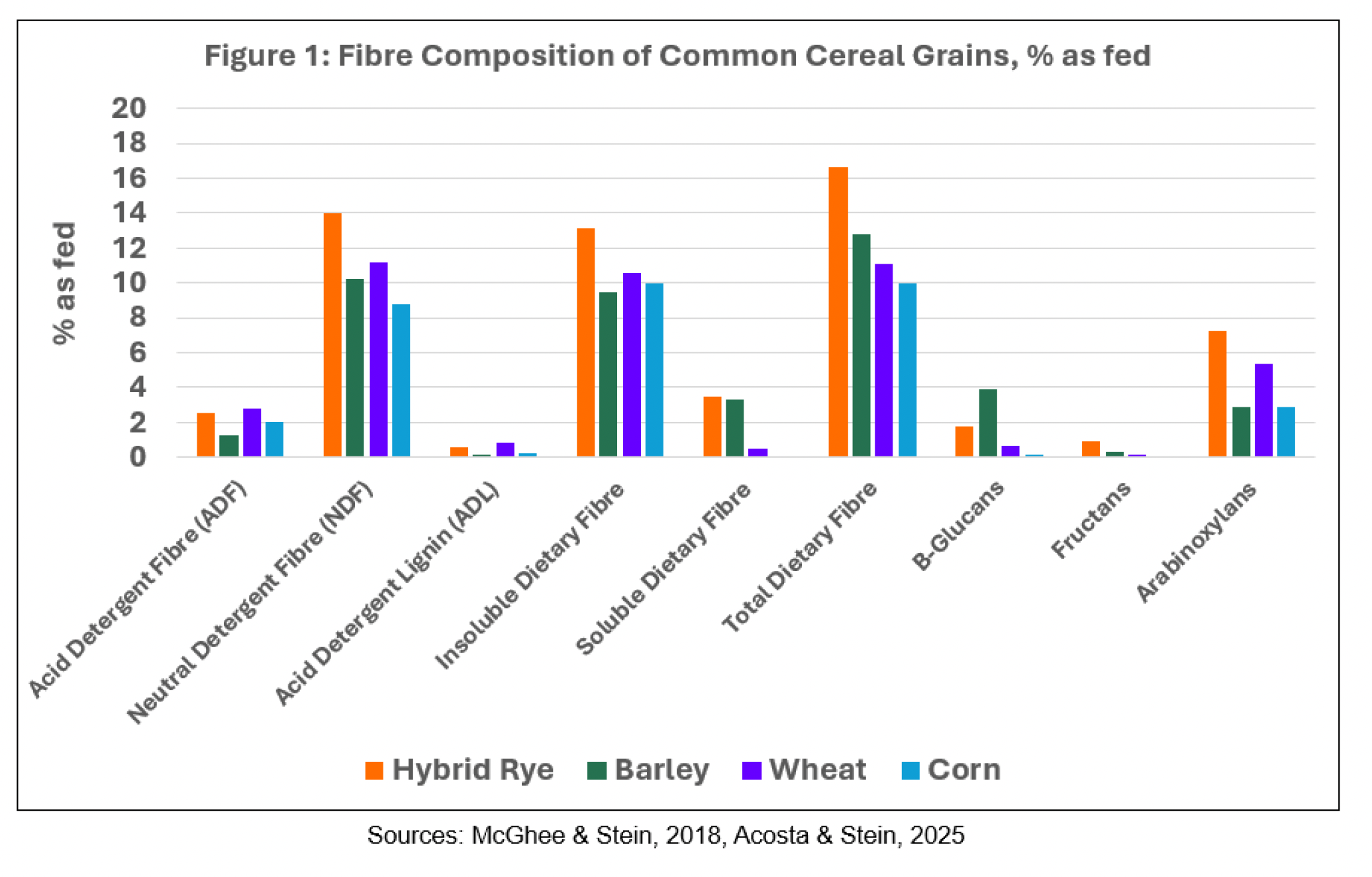
Dietary fibre in pig diets originates primarily from plant-based ingredients, including cereal grains (wheat, barley, corn), as well as their co-products like bran, distillers grains, and middlings. In recent years, we have seen the introduction of new crops like Hybrid Rye to the Canadian landscape, which is rapidly gaining interest as livestock feed. Additional sources of dietary fibre include oilseed meals (soybean meal, canola meal) and fibrous by-products such as beet pulp, soybean hulls, and other co-products from the food and biofuel industries. The type and composition of fibre can vary widely between these ingredients, influencing how it behaves in the digestive tract, its fermentability, and ultimately its nutritional value. Figure 1 highlights the fibre components of hybrid rye, wheat, barley and corn – all of which are used as primary ‘energy providing’ grains for pigs. Overall, corn has the least fibrous profile of these cereals, while hybrid rye and barley contain excellent levels of total, soluble and insoluble fibre, well suited for swine feeding.
Given this variability, not all fibre behaves the same. Differences in solubility, fermentability, and physical structure significantly influence gut function, nutrient utilization, and overall performance. As a result, understanding fibre characteristics, particularly the distinction between soluble and insoluble fractions, is essential for effective formulation.
Soluble vs. Insoluble:
Understanding Functionality
Not all fibre is created equal. One of the most important distinctions in swine nutrition is between soluble and insoluble fibre, as these characteristics largely determine how fibre behaves in the digestive tract.
Soluble fibre dissolves in water and is generally more fermentable by gut microbes. These fibres play a key role in modulating gut function and microbial activity. Examples include fructans, pectins, β-glucans, and arabinoxylans. They increase digesta viscosity and slow the rate of passage through the gastrointestinal tract, supporting microbial fermentation and VFA production. However, managing inclusion levels is important, as excessive soluble fibre can negatively impact nutrient digestibility and growth performance.
In contrast, insoluble fibre does not dissolve in water and is typically less fermentable. Its primary role is more physical in nature, adding bulk to the diet, stimulating gut motility, and supporting normal digestive function. Insoluble fibre can help maintain gut integrity and reduce the risk of digestive disturbances. Examples include cellulose, lignin and some hemicellulose fractions.
Key Benefits of Dietary Fibre in Pigs:
Dietary fibre plays an important role in supporting gut health by promoting a more stable and diverse microbial population in the hindgut. This increased microbial activity leads to greater production of VFAs, which provide an additional energy source, support immune function, and help reduce the presence of pathogenic bacteria. In nursery pigs in particular, research has shown that dietary fibre can reduce the incidence of scours and lower mortality rates. For example, studies have reported reduced Salmonella binding in the intestines of nursery pigs fed hybrid rye (Chuppava et al., 2020), as well as lower rates of post-weaning diarrhea and E. coli infections when soluble/insoluble fibre sources are included in the diet (Wellock et al., 2008; Molist et al., 2010).
Dietary fibre also plays a key role in sow nutrition. Soluble fibre is highly effective at improving satiety in gestating sows, which can help reduce aggression and stereotypical behaviours, especially in group housing systems. This improved behaviour often carries through into the farrowing period, where sows fed hybrid rye were calmer, which translated into reduced piglet crushing post-farrowing (McGhee & Stein, 2021; Mazroua et al, 2025). In addition, insoluble “bulking” fibre is well known to support gut motility, helping to reduce constipation around farrowing and easing the transition into lactation. This, in turn, can help optimize feed intake and milk production.
In grow-finish pigs, fibre can also influence behaviour and overall efficiency. While maintaining performance remains a priority, well-balanced fibre inclusion has been associated with calmer pigs in commercial settings, without negatively impacting feed intake or growth. Reduced activity and aggression can allow pigs to conserve energy, contributing to improved overall efficiency while supporting better welfare outcomes.
Practical Application:
Using Fibre as a Nutritional Tool
The challenge is not whether to include fibre, but how to use it effectively. In modern swine nutrition, the goal is no longer to minimize fibre, but to apply it strategically to support performance, gut health, and overall efficiency.
Ingredient selection is a critical first step. Because fibre composition varies widely between raw materials, choosing sources that align with the production stage and desired outcomes (e.g. gut health, satiety) is key to effective diet formulation. Ingredient selection includes understanding of the fibre profile of the primary grain source (wheat, barley, hybrid rye, corn), and of any co-products also.
Fibre level and balance must also be carefully managed. Excessive inclusion of poorly digestible fibre can reduce energy density and negatively impact feed efficiency, particularly in young or high-performing pigs.
However, moderate inclusion of functional fibre can improve gut health, stabilize intake, and support microbial activity in the hindgut.
Fibre also interacts with other dietary components. It can influence nutrient digestion and absorption by altering passage rate, enzyme access, and microbial populations. As a result, formulation strategies should consider not only fibre levels, but also how fibre interacts with starch, protein, and fat within the overall ration. Formulating on a net energy (NE) basis and accounting for available nutrients helps maintain performance while capturing fibre’s functional benefits.
Fibre-degrading enzymes such as xylanase and β-glucanase can be particularly beneficial, especially in younger pigs and in diets with high inclusion of fibrous ingredients. These enzymes help unlock the nutritional potential of fibre-rich ingredients, improving energy and nutrient utilization.
Ultimately, effective use of fibre requires a shift in mindset, from viewing it as a limitation to recognizing it as a functional component of the diet. With the right approach, fibre becomes a tool to enhance both productivity and resilience.
Conclusion
Dietary fibre was once considered a hindrance to pig production, but there is now growing recognition of its functional value and the benefits it can bring to modern systems. While further research is still needed to fully optimize fibre utilization, evidence increasingly shows that incorporating fibre, particularly soluble fibre, into well-balanced diets can support gut health and improve animal welfare across all stages of production.
Rather than something to simply manage, fibre should be viewed as an opportunity. By leveraging its functional properties, producers and nutritionists can enhance resilience, support health and welfare, and improve overall system sustainability, particularly through the use of alternative ingredients such as hybrid rye, oats, and co-products. •
— Submitted by
Laura Eastwood, Ph.D.
Laura has worked in the Canadian swine industry since
completing her Ph.D. in Swine Nutrition in 2013.