
Ventilation and What to Look For
Audience members shivering in the cold, drafty Red Deer conference centre could empathize with pigs in poorly ventilated and drafty barns.
Poorly maintained or located air inlets are one of the main causes of pig discomfort, said Colin Pratt, a Humboldt, Sask., based pork specialist.
“The inlets are what controls everything about the pigs,” Pratt told participants at the October 8, Swine Technology Workshop.
“The inlet controls what the pig feels in that room.”
Good hog barn and hog room ventilation is a mix of art, science and technology and producers and staff need to take time to continue to monitor and adjust all the ventilation systems to ensure the health of the pigs and the economics of the barn, he said.
“If you are standing in a room, take five or 10 minutes and watch what happens. You don’t want to see heaters kicking on, fans kicking on, inlets dropping, all in a short period of time. If you are a pig that lives there all day, that environment is changing too fast. We want to create a steady, constant temperature as much as possible. That change is what agitates the pig. We want to create a ventilation system that is stable and keeps that temperature as steady as possible.”
It is not different for pigs and people, said Pratt pointing at the cavernous hall.
“If we are in this room and the temperature goes up or down a half a degree we are probably not going to notice it, but if we have a big ceiling fan up there and it turns on and off, we will feel that breeze more than the slight change in temperature,” said Pratt.
“The fan’s job is fairly simple. The inlets job is where it all happens. That is what controls where the air is moving within that pen. The inlet is what mixes the cold air and the warm air throughout that room. It controls the speed of the air. It controls the even distribution of that air within the room for the pig. It is the most important part of the system.
“The inlets are really where we have to spend our time within a room. Where the air moves in the room is dictated by the inlets and not the fan.”
As well as spending time watching and listening for the air movement, Pratt recommends producers and barn technicians use a hand held wind metre, or kestrel, to test the wind speed at the air inlets to accurately know the speed of air coming out of each inlet.
By measuring the air speed coming out of the inlets, producers know if they need to adjust the angle of the inlets, or possibly increase the fan speed to move the air farther across the room.
“We manage what we measure. As soon as we measure we know what we can monitor. It is a really important tool,” he said.
“If the air is moving slower it doesn’t jet along the ceiling quite as far. It doesn’t mix. We want that air to move fast enough that it moves all that air within that room. If it just comes out slowly it doesn’t mix. We need that speed from the air to mix all that air to create an even distribution within that room to prevent drafts and pockets of stale air.”
“The Quadrant”
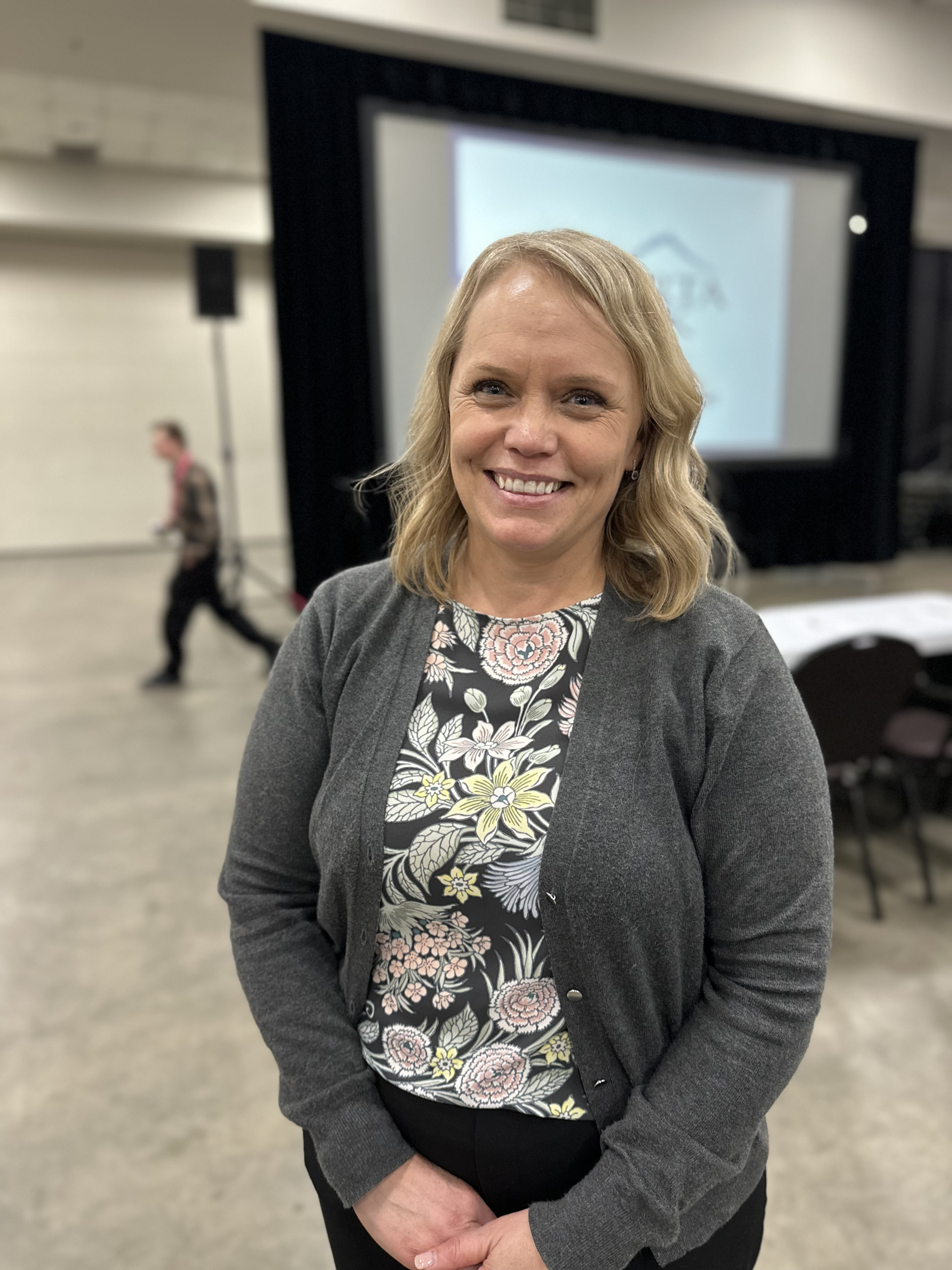
Keeping sows producing multiple litters requires focus on four factors, a research assistant with the University of Alberta’s Livestock Gentec told producers at the Red Deer Swine Technology workshop.
Focusing on all four key traits of the Fertility Quadrant will create the best fertility and keep sows in the herd longer, said Jennifer Patterson.
The four key traits in the quadrant are: age at puberty, age at service, weight at service and estrus at service, said Patterson.
“All pig companies use the same four key traits. All four traits work together to create the best fertility. The fertility quadrant is important in driving future sow lifetime productivity,” she told the group of producers and industry officials.
Patterson said focusing on all key traits instead of a single trait like litter size, will help keep sows more productive for longer. The sow lifetime is the total number of quality pigs weaned during the productive lifetime of a female, from the time the sow becomes breeding eligible until leaving the herd.
In 2015, information from the pig database Pig Champ of the 1.1 million gilts entered in the system was a stark indication of a need for improved fertility. Only thirty percent of females first served remained in the herd after six parities. The average parity of the Canadian herd is three and a half parities.
“We have an opportunity to increase our average parity over Canadian parity.”
Improving sow productivity allows producers to keep mature, productive sows in the herd longer, helps stabilize herd immunity and reduce disease risk. It also helps bring a greater return on investment of each sow. “Sows should reach at least third parity. This is when you have a positive economic return on investment.”
The top three reasons for sows leaving the herd were reproduction, lameness and productivity.
Sows from all the genetic companies have high potential to reach high productivity targets, but few barns reach that potential, she said.
“If you look at the average producing herds you can see they are quite far from the genetic potential we want to see.”
The key to increasing productivity and keeping sows in the herd longer is paying attention to gilts and their management. Good gilt management drives sow lifetime productivity.
“We believe good gilt management is part of this gap that we can start to affect.”
Patterson recommends:
*starting puberty stimulation at 23 weeks, or 160 days.
*weight of service should be between 135 kg to 180 kg.
*having one heat no service.
Gilts with early puberty have greater retention and have more pigs born by parity three. Patterson also recommends introducing boar stimulation early to allow more females and gilts to be bred at their second estrus and their target weight.
“The gilts that had a heat no serve at the first estrus had a better retention in their productive life to parity three. If we’re looking at overall retention rates having a heat no serve is really important to getting them to the third parity.”
While it’s good to know how to improve sow fertility and longevity, Patterson recommends investment in the skills development of the stock person, especially in the gilt barns.
“These people are some of the most important people in the system.”
On- Farm Postmortems
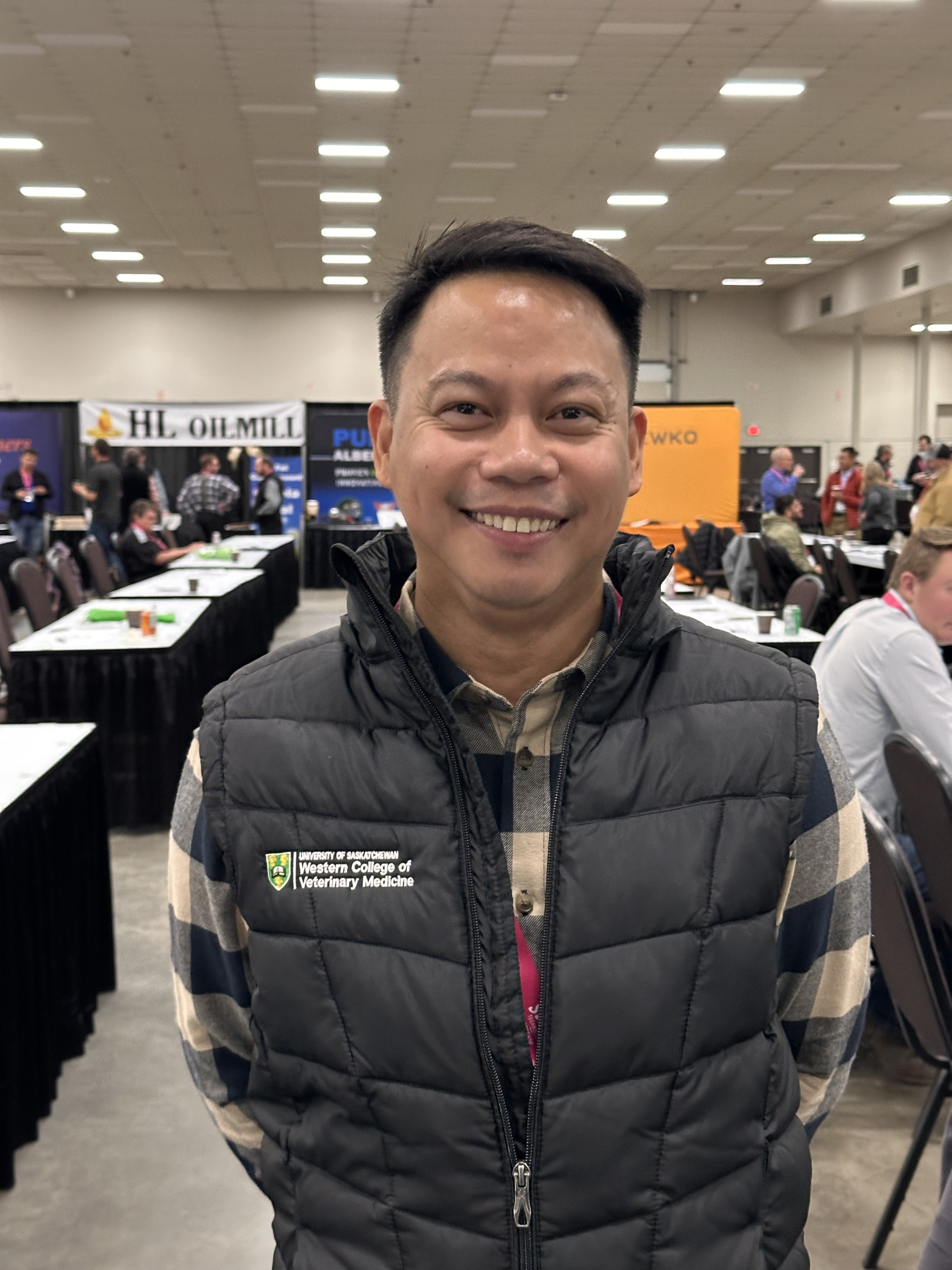
A Saskatchewan veterinarian is hoping unexplained pig deaths can be diagnosed by training pig barn staff to do post-mortems following a step-by-step guide.“Knowing what you are dealing with means you will have improved herd health, reduced losses and increased profitability,” said Mark Asuncion, a veterinarian with Precision Veterinary Services and a resident at the University of Saskatchewan.
With few vets and hundreds of kilometres between pig barns, it is often difficult to post-mortem all pig deaths. Asuncion is working with a group of veterinarians and the University of Saskatchewan to help develop a standardized post-mortem protocol and increase the number of post-mortems on each farm and help diagnose how each pig died
In 2023, data from commercial pork farms across the US with data from more than 80 million nursery pigs and 80 million finisher pigs, the number one reason for death was written as “unknown,” accounting for more than half the deaths in nursery and finishing barns.
“We want to uncover the issues. You will not know if you don’t open them,” he told producers at the Swine Technology Workshop, in Red Deer.
Asuncion said if a lot of pigs die, a veterinarian will be called in to help diagnose the problem, but if one or two pigs die and there is no cause and everyone is busy with farm work, the most common note on the file would be “found dead’ or “unknown.”
If farm staff were trained to do step-by-step necropsies, it may help shine a light on herd deaths and improve the farm’s profitability, he said.
With the help of experts, Asuncion developed a standardized guide to completing the necropsy on the farm to ensure accurate, reliable data for analysis.
With a sharp knife, knife sharpener, gloves and a cell phone for taking and uploading pictures, most barns already have all the tools needed.
Asuncion said training and practice will give farm staff the confidence needed to begin the on-farm post-mortem exams. The exams can be used as a management tool and each loss turned into a valuable tool for insight to help protect the herd, improve knowledge transfer and death prevention.
“When done safely and systematically, post-mortems will guide you with an informed data treatment to enhance herd health.”
Asuncion is part of the Swine Medicine Advancement, Recruitment and Training (SMART) Program at University of Saskatchewan’s Western College of Veterinary Medicine (WCVM).
A Day in the Life of a slaughter plant
Sometimes it only takes a little humour to help get a message across.
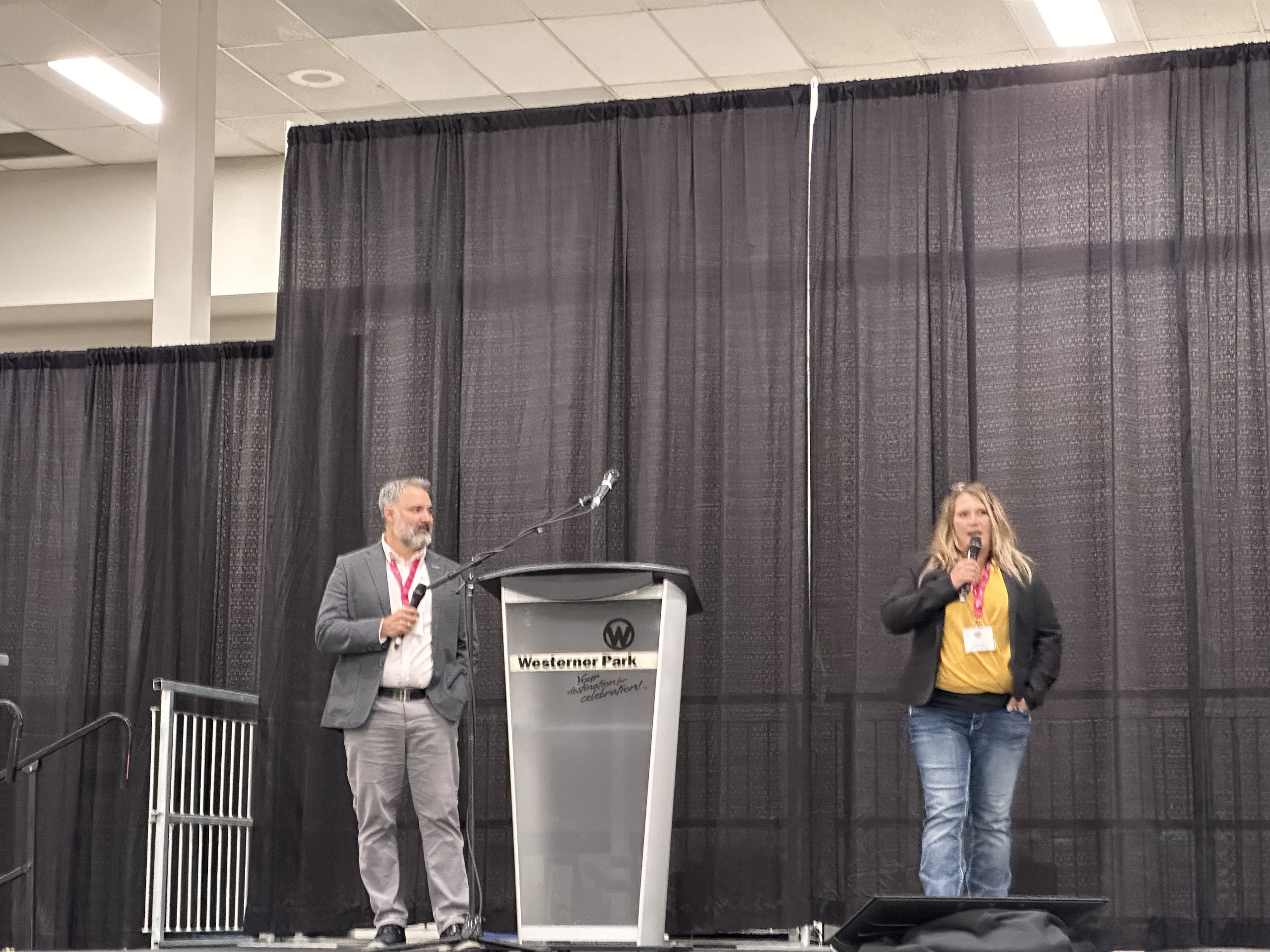
That’s what pork producer Laurie Fries and Olymel manager Ian Moon tried to do during the Swine Technology workshop in Red Deer with a chicken dance, questions and video clips from inside the barn and the processing plant.
Fries figured if she had questions about rules producers needed to follow before delivering hogs to the plant, other producers would too.
“I want to know what goes on in your world,” Fries asked Moon, Olymel’s Director of Hog Procurement.
“I want to know what we do on our farms and how it impacts the plant,” said Fries, a senior production manager at Sunhaven Farms.
While putting a tattoo in a specific location may seem nit-picky, a wrong location can impact if a producer gets paid, the producers learned.
Oil-based ink must be used to not ruin the meat, tattoos must be easy to read to ensure payment and tattoos are a regulatory requirement to identify the owner of each animal.
“It is the only way we know for sure who owns that animal,” said Moon.
Filling out the myriad of questions, boxes and details on a shipping manifest is also key to payment, regulatory rules, humane treatment of animals, and possible broken needles in the carcass is all important information to ensure the plant runs smoothly.
Fries wanted to know if it was really important if the trucker arrives at the plant on time or even if it would be fine to cancel future loads.
With 45 truck loads of pigs arriving each day, each load is scheduled to arrive at a specific time to ensure the processing line works efficiently. A few more or less loads, or a few more or less pigs on each load can add up to a big deal.
“We must plan as much as possible. It takes a big team to make it all happen. If there is a late truck, it can impact all the people” he said.
While rules can seem unreasonable, they are necessary to make the whole supply chain work efficiently, said Fries.
“Thank you for sharing the plant’s perspective. I realize how important it is now to do our paperwork and have communication so we can all work together on all of these issues.” •
— By Mary MacArthur