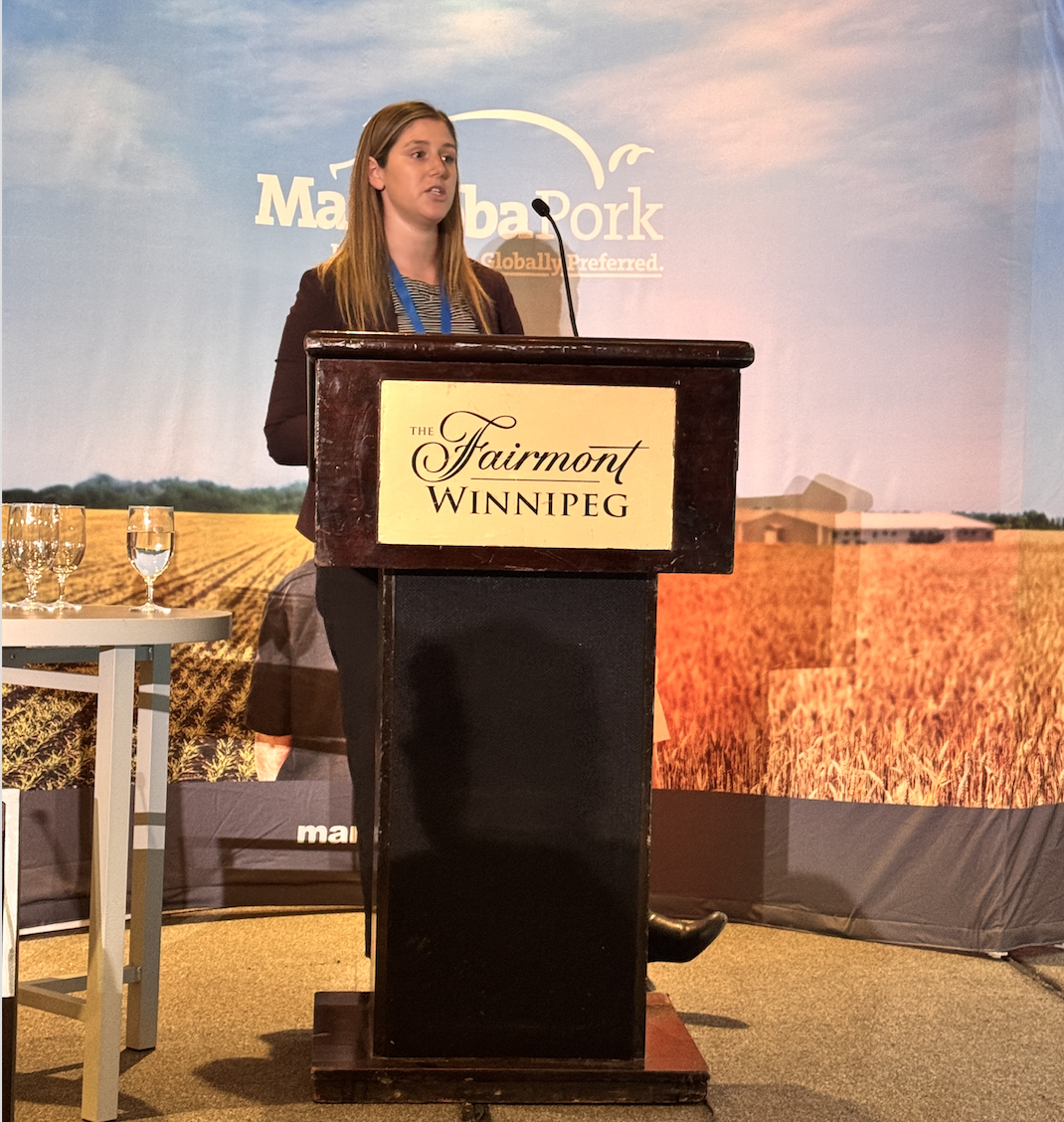
Lisa Ashton, part of RBC’s thought leadership team, addressed Manitoba Pork with a call to action for Canada’s agri-food sector: grow smarter, trade broader, and build on farmers’ strengths.
Ashton shared highlights from RBC’s latest report, Food First, which focuses on trade growth and diversification. “Farmers inform our work. Agriculture is a priority for the bank, as shown by what we do in thought leadership,” she said.
Over the past year, Ashton and her team have connected with farmers across Canada.
“Last summer, we hosted a round table at the University of Manitoba focused on infrastructure development, including anaerobic digesters,” she said. “We try to be authentic and engaged with the industry.”
Ashton explained that RBC, Canada’s largest bank, is responsible for leading national conversations on policy, economics, and the future of key sectors like agriculture.
“Thought leadership means we dig into macro research and act on it. We’re not just a think tank—we’re a do tank,” she said. “We run alliances and projects at all levels to move ideas into action.”
Trade has become a central theme. Ashton highlighted Canada’s close ties with the U.S.
“About 60 per cent of our exports go to the U.S., and we make up about 20 per cent of their agri-food imports,” she said. “We have a very integrated value chain. But with trade tensions rising, this dependence makes us vulnerable.”
She pointed to recent U.S. tariff moves. “Trump’s approach is aggressive and unpredictable. It’s testing elasticity in trade relationships,” she said. “Although some tariffs are on hold, the uncertainty remains, and pork producers feel it firsthand.”
Ashton noted that only 37 per cent of Canadian exports 2024 moved under USMCA. “Some exporters avoid the extra paperwork. But under trade pressure, we need to use every tool we have,” she said.
Canada also faces challenges with China. “Fall 2024 saw PE tariffs on China. In March, we saw shocks in ag products—meat, peas, and oilseeds. It’s only about 0.7 per cent of Manitoba exports, but it’s $2.9 billion nationally,” Ashton said. “In 2019, similar Chinese restrictions caused $20 billion in losses.”
She warned that Canada’s global market share is slipping. “We were fifth in agri-food export value in the early 2000s. Now we’re seventh. If we stay on the current path, we’ll drop to ninth by 2035,” she said.
Ashton said Canada’s exports have grown four fold over the past twenty years, but the global market has grown five fold. “We’re not keeping pace. Our competitors like Brazil and Argentina are modernizing and adopting innovations we took on decades ago,” she said.
Still, Ashton sees hope. Canada can add $44 billion in export value by 2035. That’s a 30 per cent increase. “We could grow our share from 3.7 per cent to 4.8 per cent of global exports.”
To get there, she outlined a three-part strategy: grow in markets where Canada already has trade access, aggressively pursue emerging markets, and use food as a tool for diplomacy.
“We have 15 free trade agreements. That gives us access to two-thirds of the global economy. We need to make better use of them,” Ashton said. “Southeast Asia shows the highest GDP growth, and as incomes rise, demand for meat and vegetables follows.”
Ashton noted, “The U.S., Japan, South Korea, and China are running food deficits in food diplomacy. Food can be one of our most strategic tools in trade talks.”
Domestically, Ashton stressed infrastructure investment. “We need better 5G coverage in rural areas. In Manitoba and Saskatchewan, it’s below 50 per cent. If all farmers had 5G access, we could add $2.7 to $3.5 billion to Canada’s GDP,” she said.
She also highlighted port inefficiencies. “We don’t load grain in the rain. That delays exports. If we doubled our transportation spending, we’d match the U.K. and Australia,” she said. “There are also smaller fixes like inland container facilities.”
Manitoba stands out in agri-food exports. “The province exported $10.4 billion in 2024. That’s impressive. And 70 per cent of our exports to the U.S. are value-added products,” Ashton said. “We’re not just raw commodity exporters anymore.”
She concluded with a challenge: “Under a business-as-usual scenario, we’ll fall behind. But if we lean into our strengths, we can rise again—to fifth place globally. Let’s do the work.” •
— By Harry Siemens