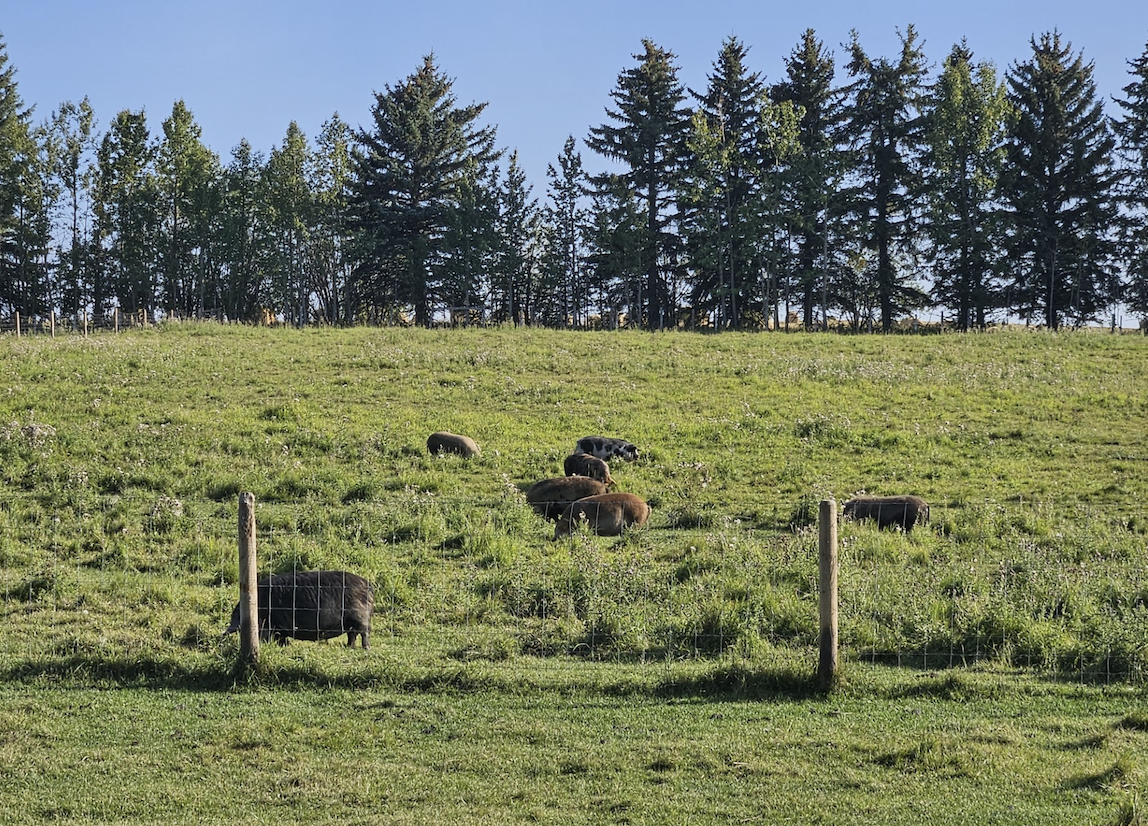
When you think of swine breeds Kunekune may not be the first breed that comes to mind.
But it is for Whispering Wind Farms near Didsbury, Alta.
“We have 25 sows and approximately 10 breeding boars. We are happy with the size of our herd so no desire to expand any farther,” related Kelly Worthington who co-owns the farm with Jon Lendvoy.
“We started our farm in 2010 where we bought property east of Carstairs. We started off with Galloway Grass Fed and Grass Finished Beef and then in 2015 we added Kunekune Pigs, closely to when they were imported into Canada.”
Worthington said initially pigs were a sort of business decision add to the farm.
“We started off with a small herd of grass fed cattle and we always had customers asking us if we had pork but the answer was always no due to the destruction of land,” she said. “That was until we heard about Kunekunes.”
Kunekune’s do have a rather unique heritage.
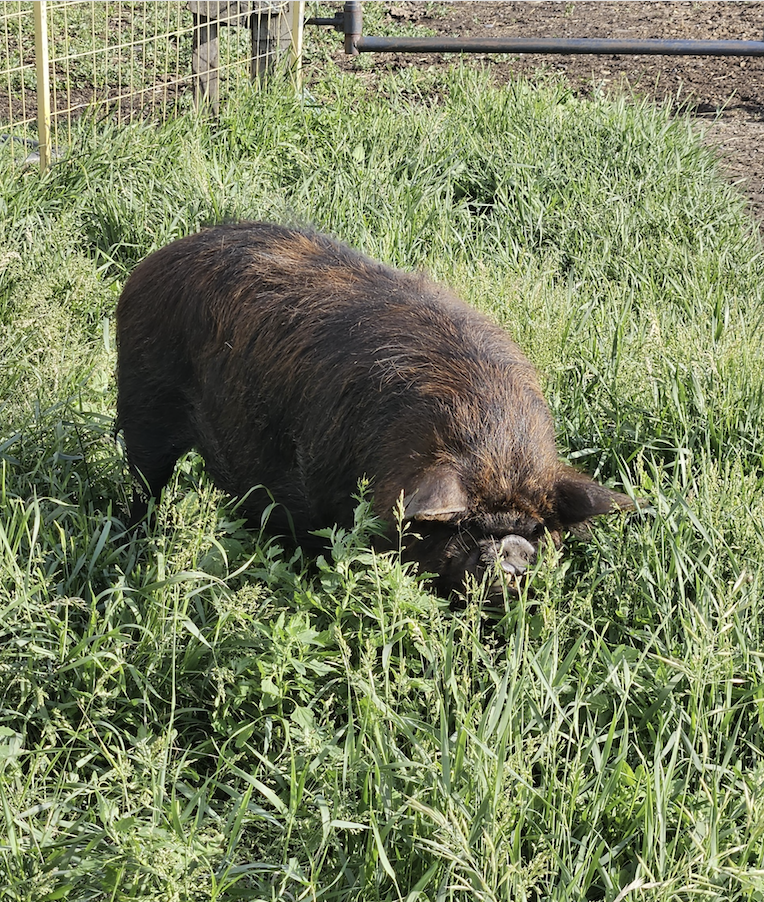
They are “a small breed of domestic pig from New Zealand. Kunekune are hairy with a rotund build, and may bear wattles hanging from their lower jaws. Their colour ranges from black and white, to ginger, cream, gold-tip, black, brown, and tricoloured,” details Wikipedia.
“The breed is believed to have descended from an Asian domestic breed introduced to New Zealand in the early 19th century by whalers or traders. They differ markedly from the feral pig of European origin known in New Zealand as a “Captain Cooker.” The native Māori people of New Zealand adopted Kunekune; kunekune is a Māori word meaning ‘fat and round.’
“By the 1980s, only an estimated 50 purebred Kunekune remained. Michael Willis and John Simister, wildlife park owners, started a breeding recovery programme, which encouraged other recovery efforts. As of 2010, the breed no longer faces extinction, with breed societies in both New Zealand and the United Kingdom. In 1993, two were imported into the United States from the UK,” and have also found their way to Canada.
So why Kunekune for Whispering Wind Farms?
“The part that drew our attention to this breed was they were known for being a true grazing pig,” Worthington told Prairie Hog Country. “What that means is they graze like cattle and sheep and don’t root pastures like other pig breeds. This was more ideal for our pasture rotation with our cattle. They eat a fraction of grain (being approx. 1.5lbs to 2lbs DM a day plus their forage).”
The breed is also well-behaved.
“They don’t test or challenge fencing, boars are easy to handle with most living in groups of more than eight,” said Worthington. “Also another thing we love, we have had easily over 200 litters and not one sow has been aggressive with us and are excellent mothers . .
“We absolutely love their docility and easy handling. They are everything we read about them.”
It’s a combination of traits Worthington said proved to make Kunekune ideal for their operation.
“The ability for them to graze and not damage our pasture — also something most don’t realize is how easy they are to load in a trailer to get processed,” she explained. We can go into a open pasture with our stock trailer, have two pig boards, a ramp and they walk right up into the trailer. For the most part, we can load 10 pigs in a pasture setting in less than 30 minutes.”
And they do need to load pigs often.
“We proudly offer breeding stock but mainly concentrate on Kunekune Pasture Pork. Last year alone we processed over 120 Kunekunes for our pork program,” she said.
Being able to market the meat is something Worthington said any new producer needs to focus attention on.
“The key with any good program is having a meat program – ‘breed the best, eat the rest,” she said. “There is a ton of fine tuning with finishing Kunekunes for pasture pork … Before one starts to offer pork, we highly recommend processing one for yourself to view your finished product and see if there is anything you would want to change in their diet and so forth. (They look for 1.5 to a maximum of 2 inches of backfat).
Another thing we highly recommend is looking for Kunekunes from a breeder that concentrates on Kunekune Pasture Pork. There is a big difference between a Kunekune that will finish in approximately 12 months at 200 pounds live or one that is 24 months old and 200 pounds live.
A breeder should be able to tell you what to look for in finishing Kunekunes and conformation that will help achieve that.
Also a great option is to buy some pork from that breeder to know if this is the breed for you.
“It’s important to note that this amazing breed is lard breed, so they will have more fat and be smaller than some other breeds but their input costs are also way lower. If you are looking for a pig that will finish in six-months and be lean, this potentially would not be the breed for you.”
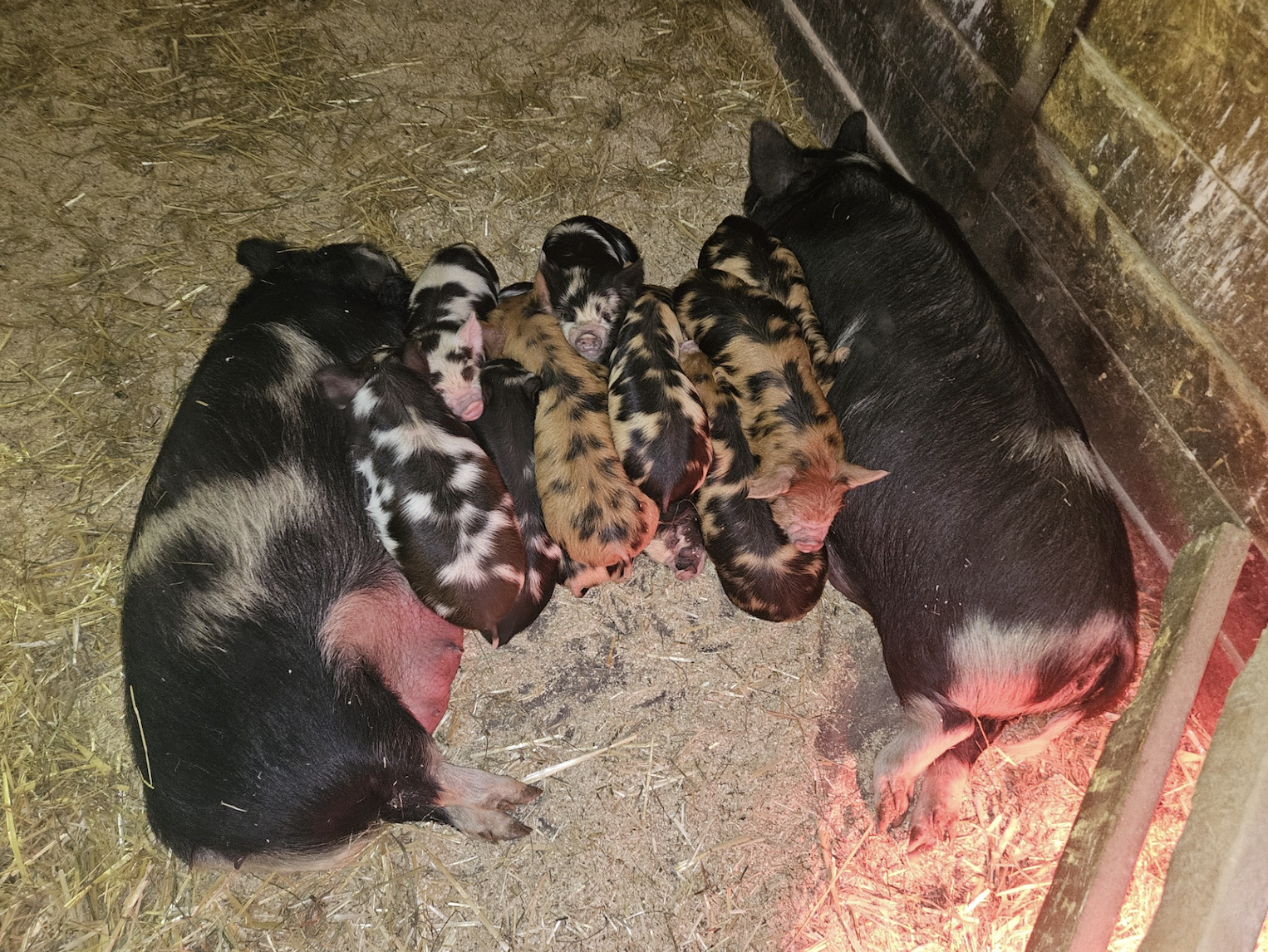
Worthington shared a little insight on how they operate with their Kunekunes. To start Kunekune piglets are born around 1.2lbs to 2.5lbs at birth and are quite small.
“As most pig breeds, piglets can regulate their body temperature and do require heat,” said Worthington. “That being said, we find being in Alberta our weather doesn’t permit for pasture farrowing. Potentially it could maybe, but we also take it very seriously, breeding livestock and it’s our goal to set them up for success. That being said, we farrow our sows in large open 12’x12’ box stalls. Each sow has her own stall. We never use farrowing crates and the sow is able to get up and roam.
“The piglets have a creep area with a heat lamp they can go to for warmth. We really believe in maternal instincts and not interfering if not necessary. We usually have five-six sows due at the same time and once the piglets are big enough to know to get away from their mom, we start to co-mingle our litters for our sows to co-parent.
“They then have a small pasture they can go out into. We find this is great for the piglets to learn social interaction and herd etiquette. We usually wean our piglets around 12 weeks of age (50-60lbs).”
They feed on a barley, wheat, pea mixture and are 100 per cent soy and corn free.
“All our finishing pigs are in pastures with access to grazing Spring to Fall,” said Worthington. “In the winter, we feed them alfalfa bales or green-feed bales which they absolutely love.
“They have fully enclosed shelters when its cold. We make sure they are draft free and filled with lots of straw.”
You can find them on Facebook, or at www.whisperingwindfarms.com •
— By Calvin Daniels
Photos supplied by Whispering Wind Farms