Experts from across Canada gathered virtually on April 29, 2025, for the second Canadian Wild Pig Summit, hosted by Animal Health Canada in partnership with Squeal on Pigs Manitoba and Manitoba Pork. The summit highlighted national efforts to control and remove invasive wild pigs and provided updates on surveillance strategies, including remote camera research conducted in Alberta.
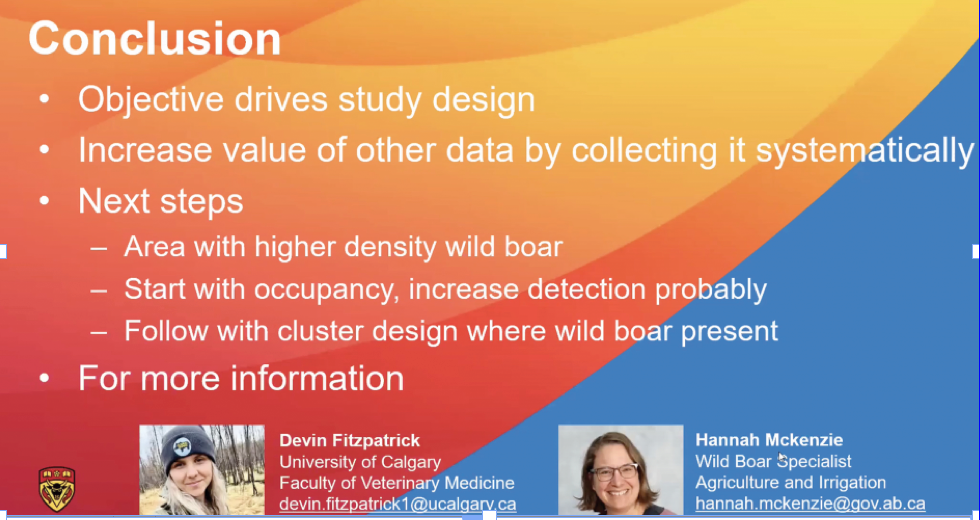
Two Alberta-based experts, Hannah McKenzie and Devin Fitzpatrick, presented their findings on using remote cameras to track wild boar populations. McKenzie, a wild boar specialist at Alberta Agriculture and Irrigation, and Fitzpatrick, a PhD candidate at the University of Calgary’s Faculty of Veterinary Medicine, described collaborative research projects to gather more reliable data on wild boar distribution and density.
Fitzpatrick explained how she deployed 84 cameras across two sites—northwest and east of Edmonton—in 2023. Her goal was to estimate wild boar density using a cluster design aligned with estimated home ranges. The group spaced cameras to meet the assumptions of both marked and unmarked modelling methods. However, low detection rates limited the effectiveness of this design. “For the first ten months, we detected wild boar at only five cameras,” she said. “Four had single events, and the fifth had 32 events, producing over 600 images.”
McKenzie and her team built on Fitzpatrick’s experience by launching a camera project in and around Elk Island National Park. The study involved over 100 camera sites and tested detection differences between two camera heights—0.5 meters, common in Europe, and one meter, used by Alberta’s Biodiversity Monitoring Institute. “We also used strawberry-scented Vaseline in PVC pipes as a lure to increase detection probability,” McKenzie said.
Researchers buffered Elk Island and Cooking Lake-Blackfoot Provincial Recreation Area by 10 kilometres to determine their study area based on estimated wild boar home ranges. Using a stratified random design, they selected sites based on forest, agriculture, and developed land cover and distance to roads, parks, and known wild boar farms. They selected 111 sites, but deployed only 103 due to landowner access challenges.. “Most of the land outside the park is private, and gaining permission proved difficult,” McKenzie said.
The project involved provincial, municipal, and federal governments, academic institutions, and industry groups. Funding came from the Sustainable Canadian Agricultural Partnership, the African Swine Fever Industry Preparedness Program, and in-kind support from project partners.
Despite deploying over 100 cameras and collecting more than 30,000 images by March 2025, the project detected only one wild boar. “It was a 15-image sequence showing a single animal investigating the lure,” McKenzie said. “But it confirmed presence in the area and showed the lure may be effective.”
Fitzpatrick explained the differences between presence/absence models, occupancy models, and density estimation methods.
“Occupancy models require multiple sampling occasions and work best when you can account for detection probability,” she said. “Density models require random camera placement and often depend on whether animals are marked or unmarked.”
Her research showed that field edges produced more detections than deeper forest placements. She also noted that Alberta’s wild boar population includes individuals with identifiable markings, allowing for partially marked modelling approaches such as spatial mark-re-sight.
Both Fitzpatrick and McKenzie emphasized that study objectives must drive camera study design. “Without a clear objective and matching design, your data will have limited use,” said McKenzie. She added that systematically collecting other data, such as trap nights, rebaiting intervals, and scouting activity, could increase the utility of future models.
The team plans to deploy cameras in Fitzpatrick’s higher-density study area northwest of Edmonton. They will begin by confirming presence using targeted sites and lures, then add clusters for density modelling. “We’re also planning overlapping thermal drone surveys and may use GPS-collared pigs to help validate the camera data,” McKenzie said.
The researchers acknowledged the intensive labour and coordination required for these studies, especially when working across jurisdictions and private land. “Field techs need experience with wild boar to pick good micro-sites,” said McKenzie. “And reviewing tens of thousands of images is a major effort.”
They are testing AI tools like WildTracks’ megaclassifier to improve processing efficiency. They also plan to refine lure deployment by suspending the scent tubes above ground to improve diffusion and reduce snow interference.
Despite limited detections so far, both Fitzpatrick and McKenzie remain optimistic. Their work contributes valuable insight to wild pig surveillance and underscores the importance of adaptive, evidence-based strategies. “This kind of research takes time and partnership,” said Fitzpatrick. “But it’s essential for managing this invasive species and protecting both agriculture and ecosystems.” •
— By Harry Siemens