Producers who have been in the hog business for long enough will recall a time when a really good sow might wean 28 pigs per year, maybe 30. Improved genetics and updated management systems have raised that benchmark considerably, to 34 or better. Reports have come from Brazil of some sows birthing litters of more than 40 pigs.
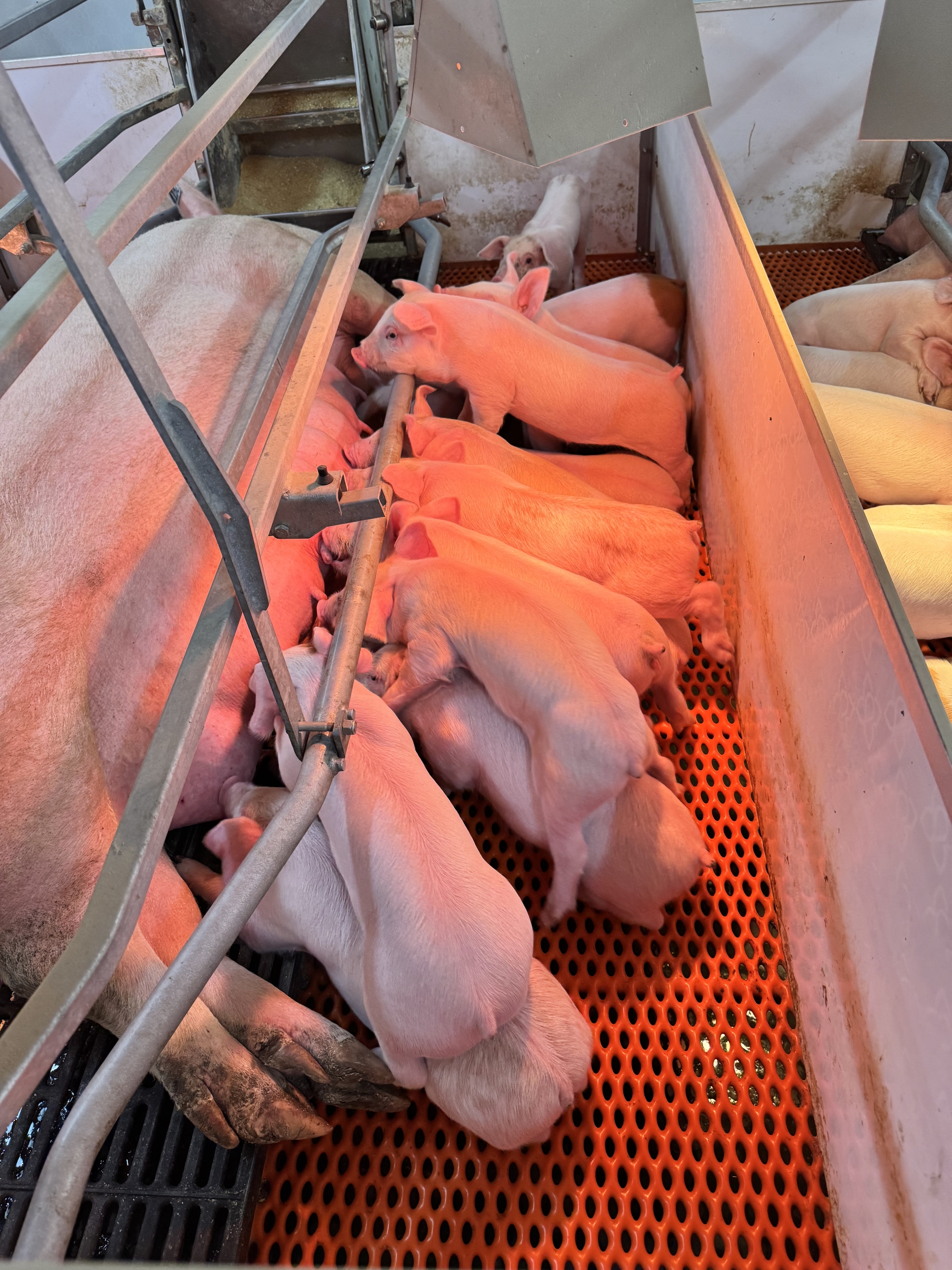
The issues that surround such highly prolific sows are many. Do they have enough functional teats to feed all their pigs? Are their pigs smaller or less uniform in birth weight? Do the sows produce enough colostrum to get their pigs off to a good start? Can they make enough milk to feed the litter? Has the piglet mortality rate increased? Has sow longevity suffered? Do the sows producing such big litters cost more through increased labour needed in the nursery?

Nutritionist Ruurd Zijlstra, a researcher and professor at the University of Alberta, has been asking those questions himself recently, so he investigated developments in North America and elsewhere.
“It’s a hot topic right now,” Zijlstra said during a chat with Prairie Hog Country.
Animal welfare activists in Europe have recently been spreading misleading and inaccurate allegations concerning health problems involving highly prolific sows and their offspring, said Zijlstra. They lay these claims to help bring donations into their bank accounts, he said.
Zijlstra’s investigation has found that breeding companies, nutritionists and other specialists are aiming for the efficiencies that can be seen through breeding highly prolific sows that have good longevity in the barn and raise large litters of healthy pigs.
Fewer, more efficient sows in the barn means farms that have converted to loose housing in their gestation rooms can raise as many hogs in the same space as what they would have raised with a larger number of sows kept in stalls, says John Sawatzky, national sales manager for Topigs Norsvin in Canada.
His company’s goal, says Sawatzky, is to breed a robust sow that will produce large litters of healthy pigs that she can raise on her own, without the need to cross foster.
Sows are not bred for any specific characteristic, but for balanced performance in five key areas, he said. That means breeders will not sacrifice one goal to achieve another.
“What a balanced breeding program basically does is it selects on many traits at the same time without focusing on one single trait and leaving others behind,” said Sawatzky.
“That’s the danger when you’re doing selection on limited numbers of traits or maybe even only one trait. For example, if you’re focused strictly on litter size, you will increase litter size, but you will have many other selection traits that remain behind and maybe, you know, regress instead of progress, so that’s one of the things that we have done forever.”
For example, breeding goals expressed for the TN70 sow in 2024 are outlined in five key areas: robustness, carcass quality, meat quality, finisher efficiency, maternal ability and litter size. Maternal ability goals include litter survival, number of functional teats, birth weight, birth weight uniformity and weaning weight.
Small producer Aron de Gier of Didsbury Alberta says, in his opinion, a good sow would have 16 functional teats from which she could feed 16 viable pigs. At the same time, because they are in the business of directly marketing pork, he and his wife, Aleah, want healthy pigs that will produce a high-quality carcass to fit their customers’ needs.
Breeders must bear all those traits in mind, says Sawatzky.
“We want the sow to be able to wean the piglets on her own. As with many businesses, companies, agriculture, whatever, labour is one of our biggest challenges.”
Therefore, labour efficiencies are achieved with a sow that can raise and wean healthy, high-quality pigs without extra work that comes with cross fostering and other interventions.
With genetic improvements also comes a need for changes in management, not the least of which is optimum nutrition for the sow from breeding through lactation and weaning.
Alberta Pork is working with the Western College of Veterinary Medicine in Saskatchewan to find the best ways to feed and manage highly prolific sows, says Quality Assurance and Production Manager Javier Bahamon.
“When you don’t feed them properly – many of these females are built to produce milk – so they will end up taking whatever it takes from their body to do that. That’s what moms do, they do their best for their offspring,” said Bahamon,
“But at the same time, how can that highly prolific sow give me the same production for the years to come?”
The number of functional teats, the number of viable pigs that are born at 700 grams or more, their ability to survive from the nursery through weaning and finishing and the challenges associated facing people in charge of their care must all be considered, said Bahamon
Improving lactation performance is critical in managing the highly prolific sow, says lactation biologist Chantal Farmer with Agriculture and Agri-Food Canada in Sherbrooke, Que.
Farmer was supervisor for a University of Guelph graduate student who presented the winning paper in the annual R. O. Ball Young Scientists competition at Banff Pork Seminar in January.
Vanessa Kloostra presented data showing that highly prolific sows require more lysine during late gestation than the National Research Council recommendation.
Increasing the lysine level to 115 per cent of the NRC recommendation during late gestation improved piglet birth weights as well as milk production in the sow, said Kloostra.
The underlying reason for breeding highly prolific sows is to increase productivity on the farm, says Zijlstra.
“That’s the underlying target, and that of course in itself is a good target.” •
— By Brenda Kossowan