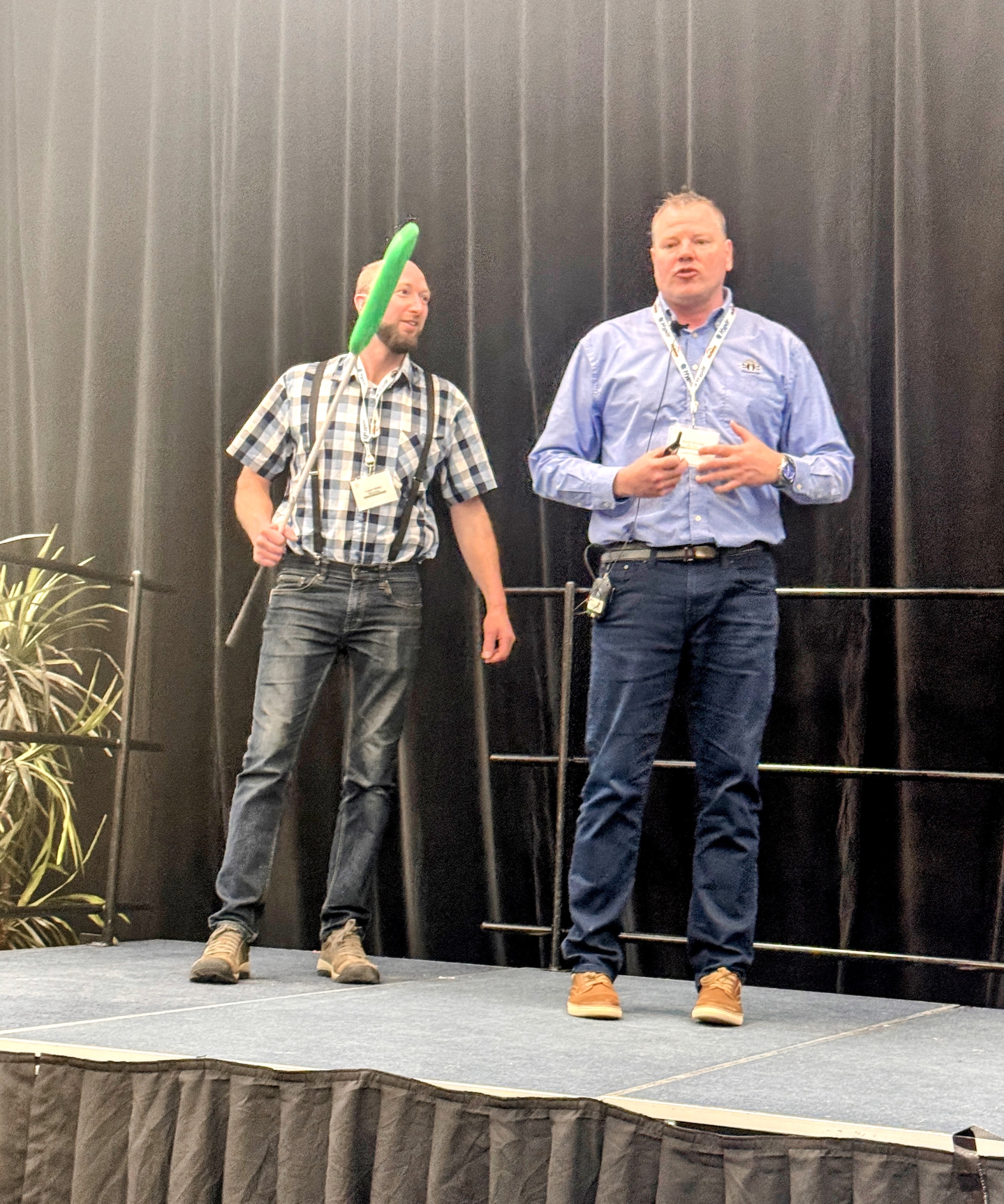
Kevin Brooks grew up on a traditional mixed farm in Rosthern, SK, where daily life revolved around livestock, including hogs, cattle, sheep, chickens, geese, and goats. The farm’s foundation combined grain production with livestock, giving him a deep-rooted understanding of agriculture from an early age.
Today, Kevin works with Olymel Swine West in Humboldt, SK, specializing in swine production. His focus centers on animal handling and welfare, and he collaborates with production teams on staff training, transport education, and on-farm projects. With over 20 years of experience in large-scale hog operations across Saskatchewan, Alberta, and Manitoba, he has developed a wealth of practical knowledge.
Known for his unconventional approach to training, Kevin challenges traditional thinking with interactive, engaging, and thought-provoking sessions. His emphasis on low-stress animal handling improves pig welfare and enhances staff efficiency and morale. His passion for teaching is infectious, often leaving participants with a new perspective on animal care and workforce management. His ability to connect with animals and people makes him a respected leader in the field.
Brooks believes the key is understanding their behaviour when handling pigs with minimal stress. “The biggest thing is recognizing what the pigs are doing and what they’re thinking,” he explained. “In the past, we didn’t always realize what was stressing them. But if we understand what the pig is trying to do, we can work with it instead of against it.”
He compares the process to a game of tag. “In a weird way, pigs are almost playing tag with us. It’s about body position, allowing them to move naturally and letting them ‘win’ by escaping in the right direction. If we can do that, it’s a big win.”
But teaching handlers to adopt this mindset? “Very challenging,” Brooks admitted.
He acknowledged that traditional methods of moving pigs relied on noise and heavy pressure, techniques passed down through generations. “The old-school way, the way my dad taught me and the same for him, was to use noise and force to get animals moving,” he said. “The challenge is that older employees often struggle the most with changing their approach.”
However, he has seen firsthand that repeated training makes a difference. “If we can repeatedly show and reinforce them, they become effective. One of my worst loading employees is now one of my best—but it took three training sessions to get them there.”
Brooks explained that some people catch on immediately when asked how many workers grasp at least 51 per cent of the training after the first session. “If they can see and understand it, they get it right away,” he said. However, for others, it becomes clear that loading pigs may not be the right fit. “Some people just aren’t suited for the job—maybe they’re better off doing pressure washing or other tasks instead.”
Brooks said that not everyone will naturally have the skill set for low-stress pig handling, but understanding the “why” behind it makes a significant difference. “If people understand why it matters, they’ll usually do a good job,” he said. Beyond better handling, there are clear economic benefits as well. “Lower stress means pigs adapt faster when they move—from an iso-wean to a feeder, for example. They start eating sooner, their stress levels drop, and they’re less susceptible to disease at the next farm.”
This, in turn, can lead to reduced treatments, lower mortality rates, and an easier job for both handlers and truck drivers.
A very solid attendance at this years Manitoba Swine Seminar nearly 600 on day 1.•
— By Harry Siemens