In an industry dominated by intensive, large scale operations, most with a fairly similar genetic base, there are still those who choose a different path in the swine industry.
Hogs and Horns Homestead, located at Lavoy, Alta. – about an hour east of Edmonton – is one such operation.
They are a smaller operation, raising their pigs outdoors, and choosing to focus their efforts on preserving rare breed genetics in the process.
Jen Baker, who owns the operation with partner Monica Baker, said they began their hog operation basically because of a birthday request. Baker explained Monica had said she wanted a pig for her birthday, so she had bought her a couple of Vietnamese pot-bellied pigs.
That however was not exactly what Monica had in mind. She had actually ended up ‘ordering’ a large black/Kunekune sow, and that started the partners on a path to rare breeds conservation.
“We started in late 2019. We got the large blacks in the summer of 2020,” said Baker, adding prior that “we didn’t really have a set plan when we moved here.”
With the one sow on their farm the research began.
“Our farming adventure started with a love for animals and a passion for raising our meat,” notes www.hogsandhornshomestead.ca “During this process, we learned how close to extinction many heritage farming breeds are. We are working hard to increase numbers through ethical breeding and bloodline tracking while promoting awareness. Moving closer, one step at a time, to help save these unique breeds.”
In doing the research Jen, who is a flight medic as well as a farmer said they quickly came to recognize many breeds of hogs – and other farm species too – are struggling to survive as numbers have declined and in the process distinct bloodlines have been lost.”
Soon they were striving to preserve heritage breeds that are critically endangered.
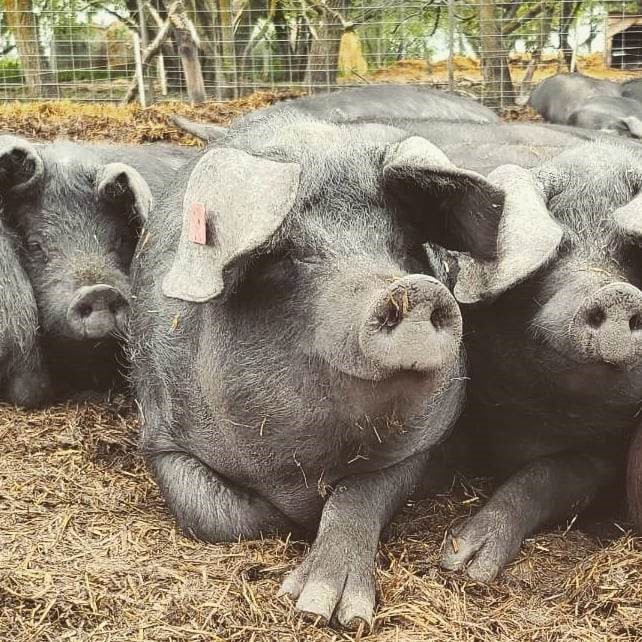
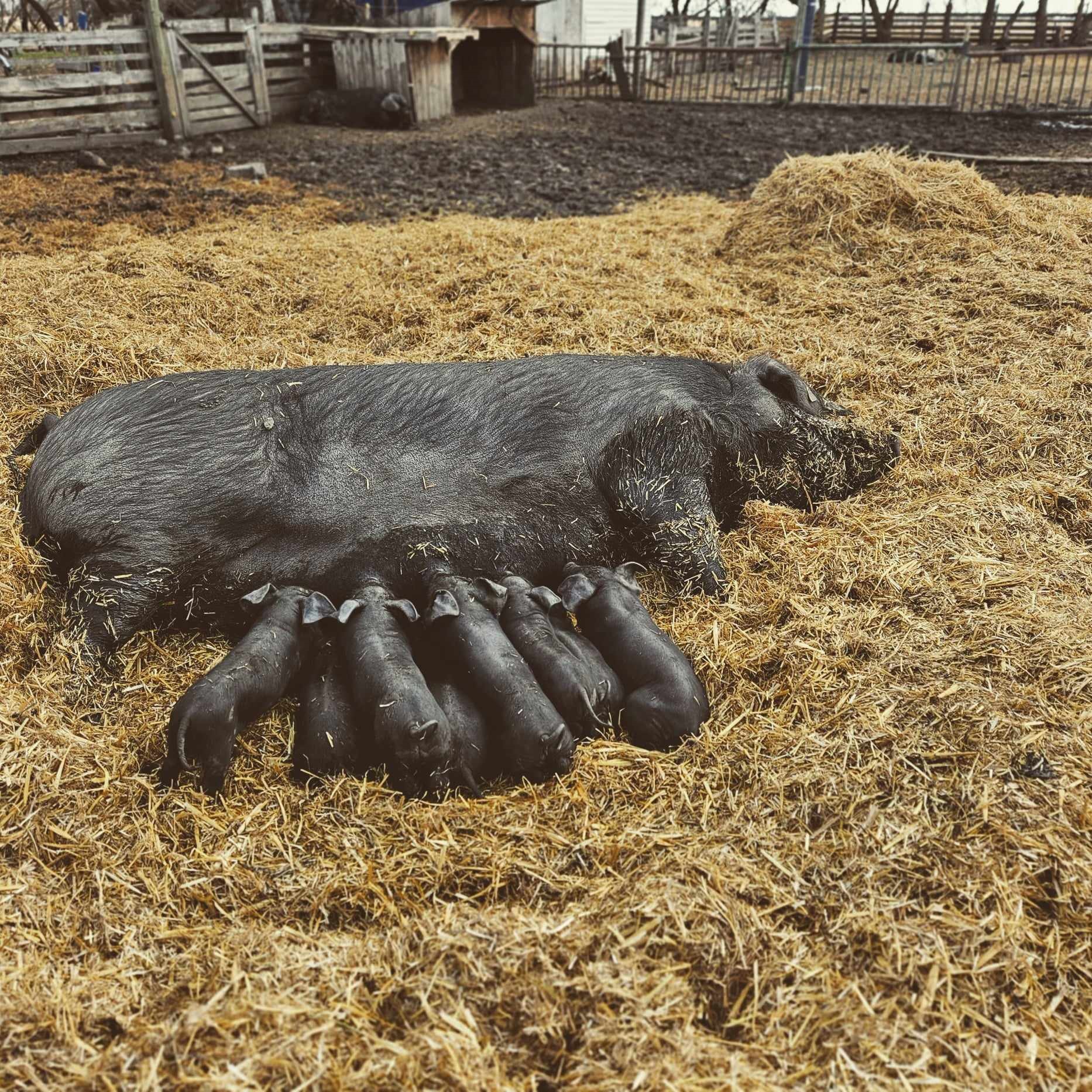
The Large Black has become the main swine herd, with three boars to keep bloodlines as diverse as possible, and 17 sows, making it almost assuredly the largest herd in Canada.
Jen said they initially focused on Large Blacks because of the initial crossbred sow and then learning they are one of the rarer breeds in Canada, adding numbers are in decline.
“Since we’ve started we’ve seen several herds go,” said Jen.
They also have smaller herds of Red Wattle and Ossabaw, and have had Kunekune a small breed of domestic pig from New Zealand, and Mangalitsa which is a Hungarian breed of domestic pig which grows a thick, curly coat of hair, and Meishan, a breed from China.
The Ossabaw Island Hog is interesting as it is a breed of pig derived from a population of feral pigs on Ossabaw Island, Georgia, United States. The original Ossabaw hogs are descended from swine released on the island in the 16th century by Spanish explorers.
But why pigs beyond a birthday wish?
The website provides detail.
“Our passion is pigs! We regularly get asked why pigs? We believe swine is one of the food industry’s most misunderstood animals,” it notes. “Typical pork is from indoor confinement farms. There is virtually no pasture pork available in Alberta grocery stores. The pork industry and regulations have been made for indoor confinement farming, and we would like to see this change. Pigs are incredibly smart and social creatures. We feel they deserve to be treated with the utmost respect and quality of life regardless of their purpose. Whether these animals are kept as pets, breeders or destined to sustain us, their humane treatment should be a top priority. We provide all of our pigs with enrichment activities and attention daily. In turn, this provides a less stressful environment.”
The pigs are raised as naturally as possible.
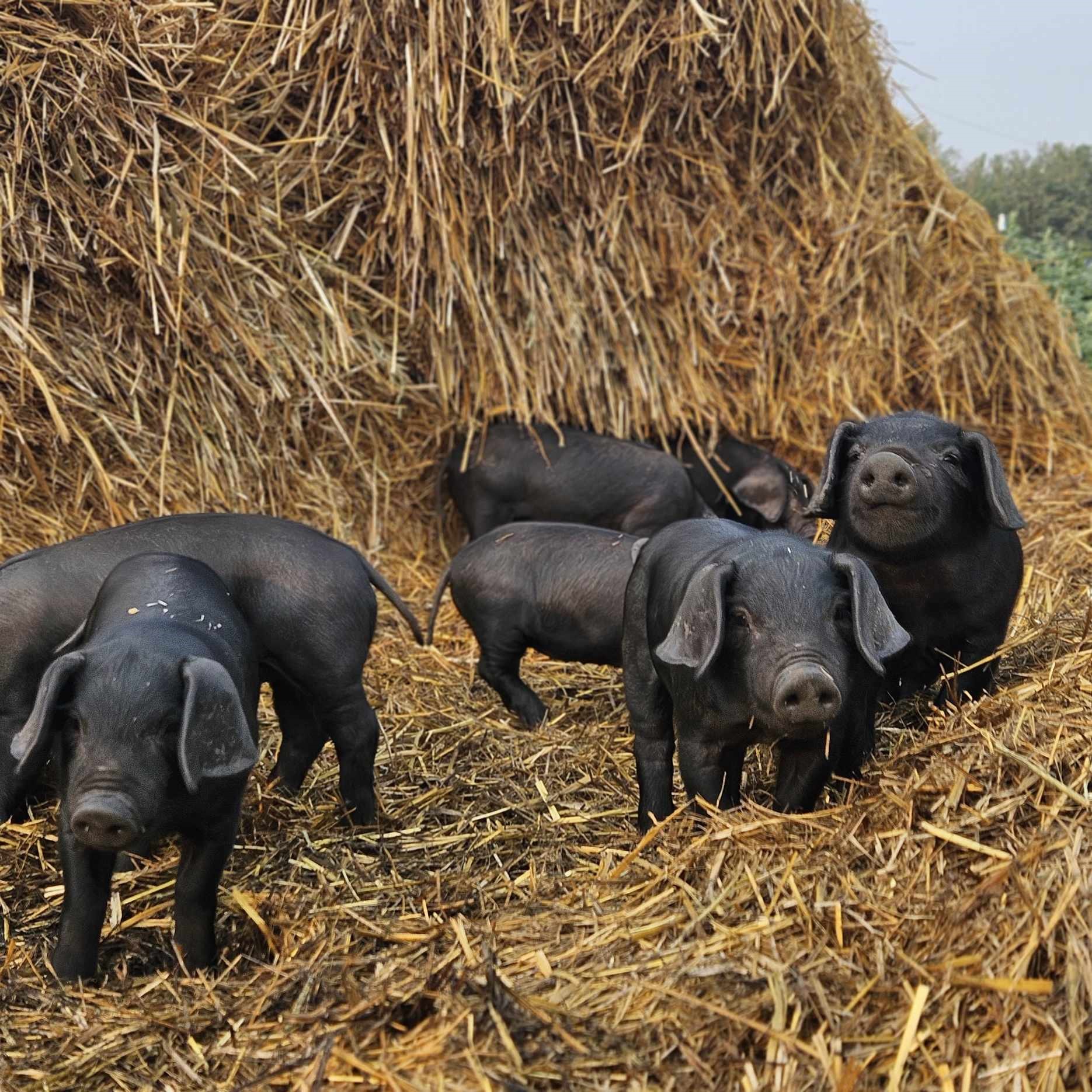
“How our animals are raised is very important to us. We believe that though they may be destined to feed us, all animals should be respected regardless of how short their lives may be. These animals should be given the best life possible, regardless of how short their lives may be,” details the farm website.
That dedication to pasture pigs meaning doing it all outdoors.
“We have farrowed at all times of year,” said Jen. “However, now we try to have our farrows in the spring and fall as we find they have the best survival rates at those times.
“We typically wean at six to eight weeks.”
While preserving the breeds is a core goal – happily selling breeding pods to anyone wanting to start or expand a herd, some stock of course ends up as pork.
“For non-breeding stock, we either sell as piglets for other small farms to grow out for meat, or we grow out for meat and sell meat by the cut through farm-gate sales,” said Jen. “Most of our marketing is through social media, word of mouth, and our website.”
Still, breeding stock sales are the most coveted as it keeps the breed going.
With that in mind, Jen said it’s more than just raising the rare breeds – animals need to be registered so bloodlines can be traced and understood.’
“As soon as we stop registering a bloodline it’s lost,” she said, adding there may be farms with Large Black sows, but if they are not registering, they don’t build the breed in terms of conservation.
As bloodlines dwindle it becomes more difficult to finds stock not already related to what you have. It’s a situation which had Hogs and Horns Homestead involved in a recent importation of Large Black semen from Britain. Jen said they are excited to see what that will do for their herd.
In addition to rare breeds of swine Hogs and Horns Homestead raise rare sheep too – the main focus being Jacob.
The Jacob is a British breed of domestic sheep. It combines two characteristics unusual in sheep: it is piebald—dark-coloured with areas of white wool—and it is often polycerate or multi-horned. It most commonly has four horns.
“Our sheep are used for fibre, skulls, hides and meat,” noted their website. •
— By Calvin Daniels
Photos supplied