
Rare breeds of swine – well all livestock – have long intrigued.
Many of the now rare breeds – Berkshire / Tamworth / Large Black and others – are foundational in terms of agriculture, the genetics of the past often the roots of stock today, albeit many generations removed.
But not all rare breeds are about filling the needs of farmers to produce pork in different eras and farm conditions.
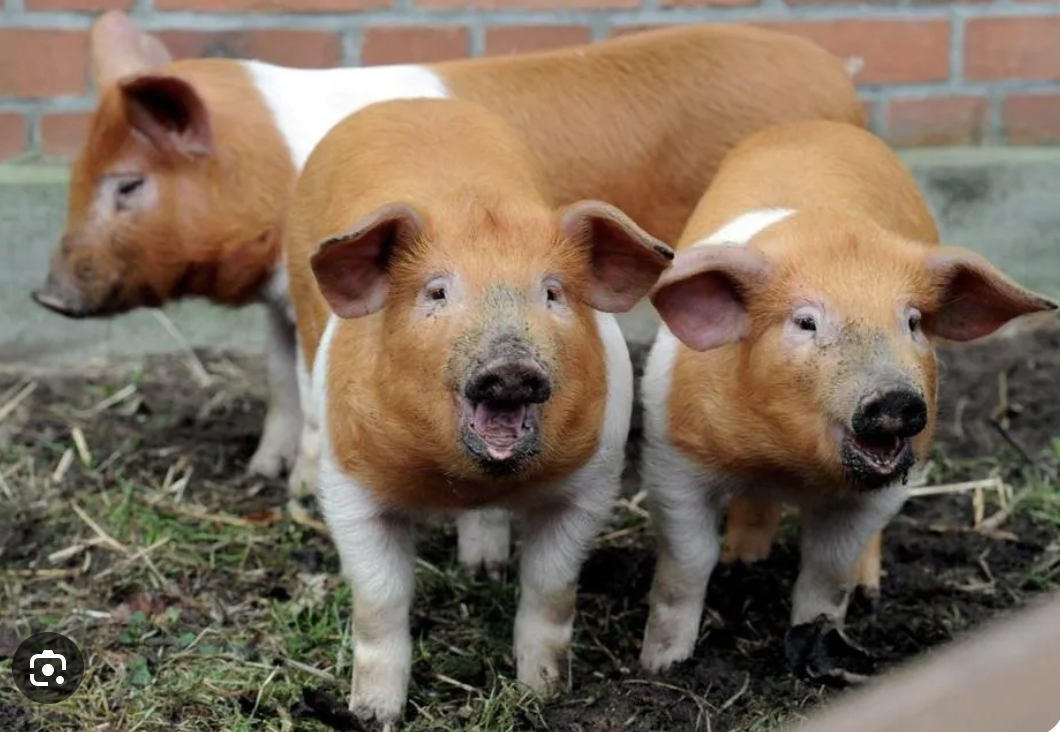
For example, I recently came across the Husum Red Pied, better known as the Danish Protest Pig.
Now while obviously not Canadian the idea of a ‘Protest Pig’ sent this writer down an Internet ‘rabbit hole’ to learn more.
While one might not write a book based on what is on the Internet regarding the Husum Red Pied, it shows up from a number of sources – even several social media postings on Facebook.
“In the early nineteenth century when the Danish in North Frisia, Southern Schleswig-Holstein (today part of Germany), were banned from having the Danish flag by the ruling Prussians, they bred a pig in their heraldic colours to flaunt their resistance,” notes Rare Breeds Trust of Australia on its FB page.
“It’s thought the Tamworth went into its breeding. Great breed, sadly very rare now. None in Australia.”
The breed actually arose as a protest as a result of war.
“The story dates back to the 19th century when Denmark and Prussia couldn’t agree on where to draw their border. At that time both countries refused to concede any ground and wanted to control the southern Jutland Peninsula, which today is part of the German state of Schleswig-Holstein,” detailed a 2021 story at www.dailyscandinavian.com written by Tor Kjølberg.
“In 1848, the countries fought, with Denmark winning claim to the land. More than a decade later, the land was up for grabs again as the Second Schleswig War erupted, this time with Prussia declaring victory.”
With Prussia in control things changed and not for the better for locals, including farmers. They were living under the rule of the Prussians, who prohibited all use of the Danish flag. They could not raise their flag.
“Through a crafty program of crossbreeding, Danish farmers tried to create a new breed of pig that faintly resembled their beloved home’s flag. It wasn’t terribly difficult, they decided to use biology as their secret weapon. The banner of Denmark is relatively simple—a flat red background covered by a long, white Nordic cross — so all the pig needed was a coat of red fur and one or two prominent white belts. They named it Protestschwein, the Danish Protest Pig,” wrote Kjølberg.
The result of the breeding program was the Husum Red Pied or Rotbunte Husumer.
“It is a red pig with a white belt or saddle which includes the forelegs, so the head, neck, rump and hind parts are red; it is considered a colour variant of the Angeln Saddleback. The name derives from that of the town of Husum on the coast of Nordfriesland in northern Schleswig-Holstein, where pigs of this kind are documented from the late nineteenth century,” details the breed’s Wikipedia page.
In general the breed looks much like a Hampshire, but red in colour instead of black, and a lop ear.
Again Wikipedia notes, “it was recognized as a breed in 1954; the last time a sow with piglets was seen at a show was at Rendsburg in 1968, and thereafter it was thought to be extinct.”
But that has proven to not be the case.
Pigs corresponding to the description of the breed were seen again in Berlin in 1984, and a breed association, the Interessengemeinschaft Rotbuntes Husumer Schwein, was formed in that year.
While still existing the breed is very rare.
In a 2025 article www.amusingplanet.com noted fewer than 60 of these rare animals survive, primarily in zoos, with Wikipedia pegging the number at about 140.
Breeding populations exist in the Berlin Zoological Garden, the Hanover Zoo, the Tierpark Arche Warder near Kiel, in the ZOOM Erlebniswelt Gelsenkirchen, in Dalmsdorf (Mecklenburg), Hof Lütjensee, and on the Archehof Blumencron. The Dortmund Zoo and the Tierpark Krüzen house small populations too. . . The German federal state of Schleswig-Holstein supports preservation of the breed for its cultural value,” notes Wikipedia. •
— By Calvin Daniels