
With Manitoba pork producers facing the July 1, 2029 group sow housing deadline, Manitoba Pork’s Group Sow Housing Forum delivered one clear message: every barn is different, and careful planning is essential.
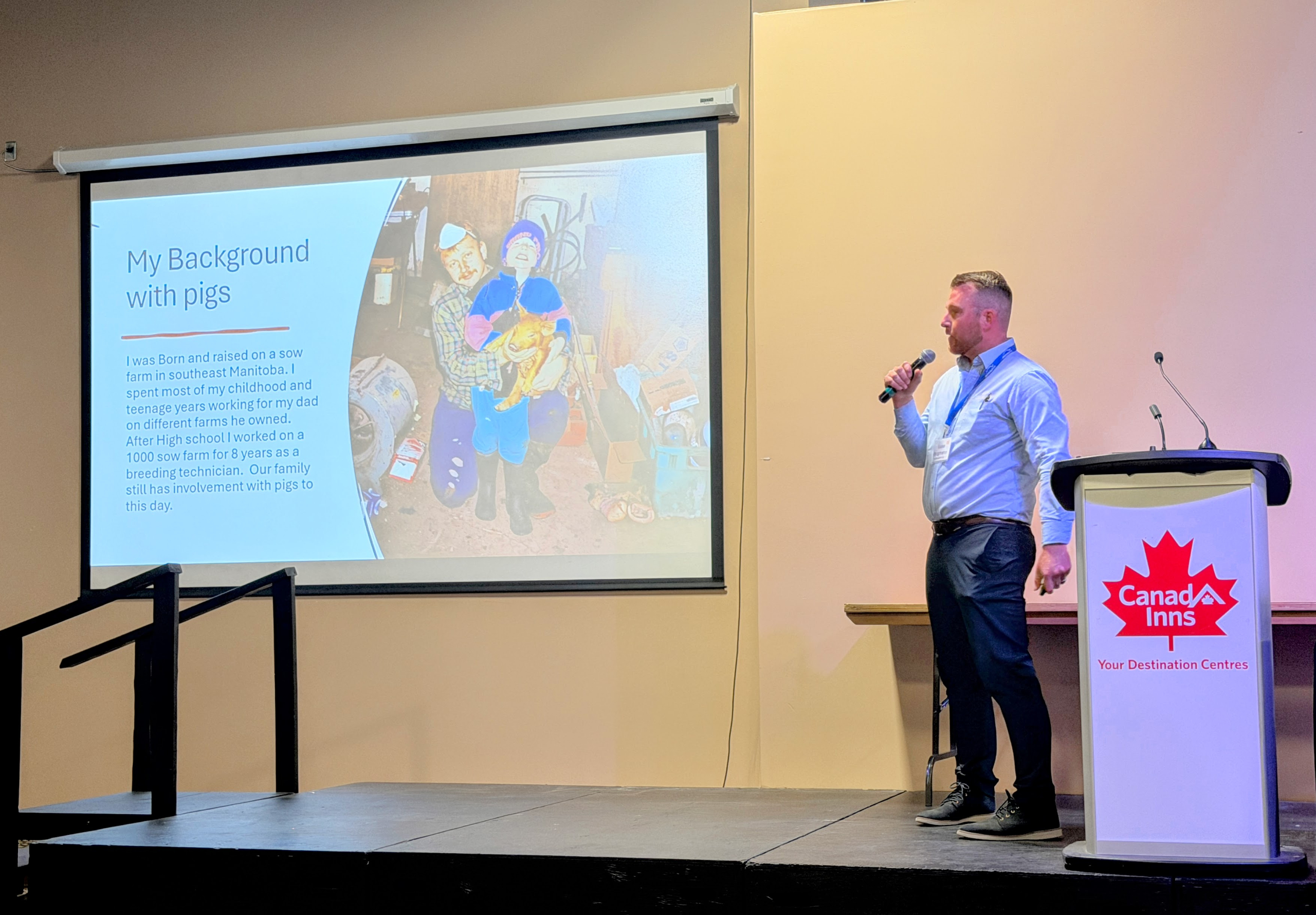
The forum was held at Canad Inns in Portage la Prairie and brought together producers, equipment suppliers and technology companies to share practical experience and housing options. Among the presenters was Luke Bergmann, co-owner of Buckingham Ag, who outlined the company’s shoulder stall system developed in partnership with Danish manufacturer ACO Funki.
Bergmann grew up on a family hog farm and later worked for eight years as a breeding technician at a 1,000-sow loose-housing operation near Blumenort. Today, he helps producers retrofit existing barns through Buckingham Ag and BLR Project Management.
“We’ve got a great industry here with a lot of knowledge,” Bergmann said. “If you’re considering a conversion, talk to fellow producers. Visit their farms. Ask what worked and what they’d do differently before making decisions for your own operation.”
After visiting farms and manufacturing facilities in Denmark over the past several years, Buckingham Ag selected ACO Funki.
“We wanted to bring European expertise to Canada, but we also recognized Canadian barns are different,” Bergmann said. “We’ve adapted the designs to fit our production facilities and management styles.”
Rather than relying on electronic sow feeding, the company’s shoulder stall system offers a simpler approach.
“It’s a low-tech system,” Bergmann explained. “There are no software upgrades or complicated electronics. It’s economical, labour-friendly and simple for staff to manage.”
The system uses individual shoulder stalls during feeding while allowing sows to move freely throughout the pen. Bergmann recommended stalls spaced 20 inches on centre with solid dividers to reduce stress and ensure each sow has access to feed.
“A sow can only eat if she has a chair at the table,” he said. “That chair is the shoulder stall.”
Much of the discussion focused on retrofitting existing barns instead of building new ones.
Bergmann said each design begins with producers mapping animal flow, pen size and daily chores before construction starts. In many cases, unnecessary hallways can be eliminated to create additional lying space without reducing sow numbers.
Once permits and approvals are complete, a typical renovation could take four to six months, although every project differs.
The work can often continue while production continues by renovating one section of the barn at a time.
During the question period, producers asked about water systems, manure buildup beneath feed troughs, stall dimensions and sow training.
In response, Bergmann said routine pen maintenance addresses feed and manure accumulation, while supplemental water drinkers improve sow comfort. He also noted that the shoulder stall dimensions reflect decades of European experience in reducing stress during feeding.
Looking ahead, Bergmann encouraged producers not to wait until the final years leading up to the 2029 deadline.
“Manitoba is recognized as a leader in pork production,” he said. “We have producers who have already gone through this transition. Learn from them. Use the knowledge that’s already here to make the best decision for your farm, your staff and your future.” •
— By Harry Siemens