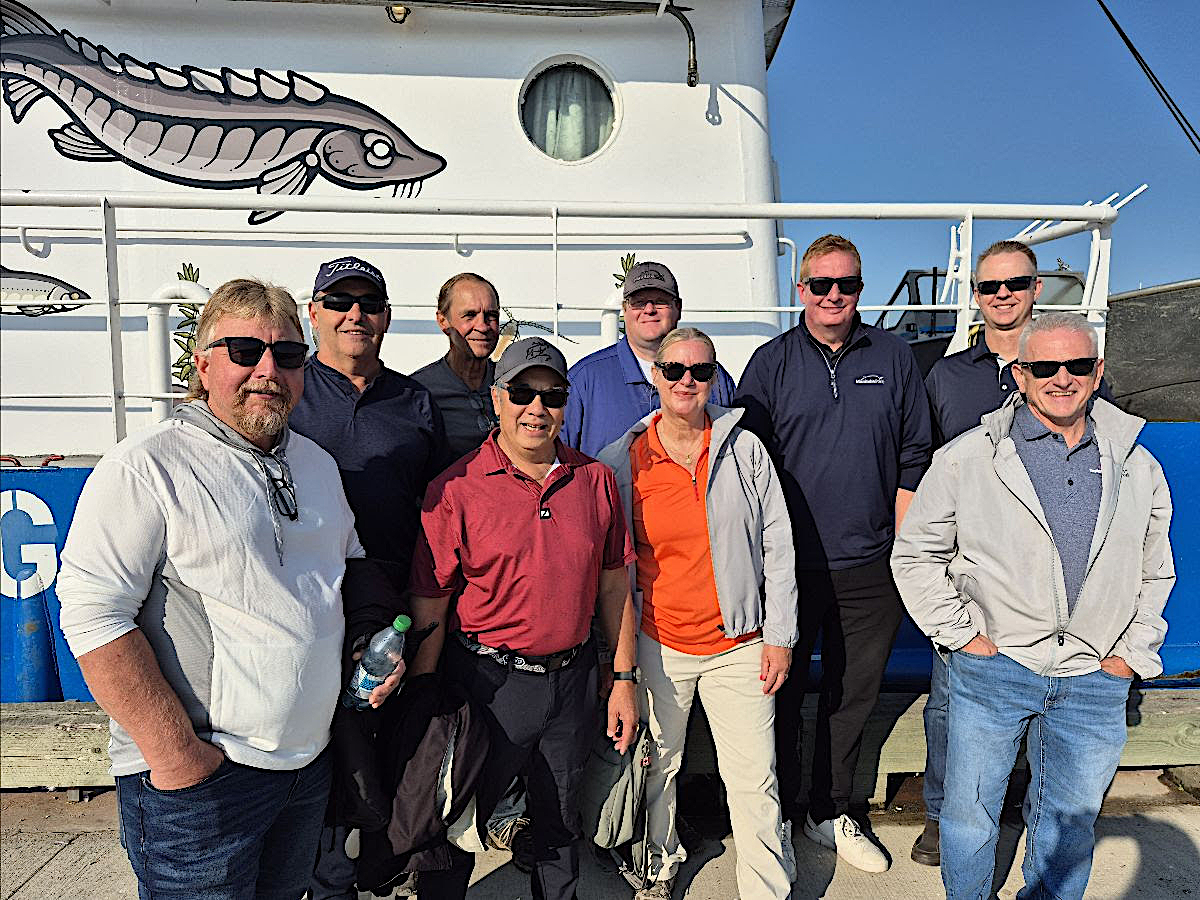
during a Lake Winnipeg tour focused on water quality, research and
environmental stewardship. Photo courtesy of Manitoba Pork.
Manitoba Pork has supported Lake Winnipeg research for more than 15 years. A recent trip aboard the M/V Namao gave pork producers and industry representatives a firsthand look at how they’re using that support.
Manitoba Pork staff, board members and district advisors joined the Lake Winnipeg Research Consortium for a research tour of the lake’s south basin, where the consortium operates the Namao as its main research vessel.
The relationship is not new. Manitoba Pork said its financial support for the Lake Winnipeg Research Consortium has continued for more than 15 years, and the recent tour was part of that collaboration.
During the trip, researchers demonstrated equipment used to collect water samples at 65 sampling sites across Lake Winnipeg.
Manitoba Pork said the demonstration showed participants how farmers help researchers better understand the lake’s ecological dynamics.
One challenge is the enormous size of the Lake Winnipeg watershed. It covers parts of four Canadian provinces and three U.S. states.
According to Manitoba Pork, consortium researchers explained that understanding water quality requires more than studying Lake Winnipeg itself. It also requires collecting information and connecting the work of numerous groups studying the lake and the land draining into it.
Increasing collaboration and awareness of that research will be important in the coming years.
Manitoba Pork is also becoming more directly involved in discussions about nutrient research.
Grant Melnychuk, Manitoba Pork’s director of sustainable development, research and data management, was recently appointed to the Lake Winnipeg Stewardship Advisory Group.
Formed in spring 2026, the advisory group will provide Manitoba’s Minister of Environment and Climate Change with recommendations on future research that could help reduce nutrients entering Lake Winnipeg.
Manitoba Pork said this could include updating estimates identifying nutrient sources by waterway and by sectors such as urban, industrial and agricultural sources.
The organization said it requested establishment of the advisory group because discussion and future regulations concerning Lake Winnipeg should rest on scientific evidence rather than assumptions or social media commentary.
Manitoba Pork also points to manure management as an important part of the industry’s environmental record.
Statistics Canada data cited by Manitoba Pork shows that more than 90 percent of manure in Manitoba is either injected into the soil or incorporated immediately after application, and Manitoba Pork said this represents the highest rate among Canadian provinces.
Farmers increasingly combine manure application with precision soil testing, manure management planning, GPS technology and near-infrared technology.
The objective is to apply manure as an organic fertilizer at rates crops can use while minimizing the potential for nutrient runoff.
The Namao tour allowed Manitoba Pork representatives to connect those on-farm practices with the larger research effort underway on Lake Winnipeg.
The organization intends to continue supporting the Lake Winnipeg Research Consortium and plans more sustainability initiatives in coming years.
Those initiatives will communicate the sustainability work already underway on Manitoba hog farms while also seeking further opportunities to improve.
For Manitoba Pork, the tour’s message is that protecting Lake Winnipeg requires good information. With a watershed stretching across international and provincial boundaries and many potential nutrient sources, decisions affecting farmers and others need current research and measured evidence.
The industry’s continuing involvement with the consortium and the new advisory group gives Manitoba hog producers a place in that science-based discussion. •
— By Harry Siemens