If there is one thing that can be said about winters in Canada — weather can be extreme.
Certainly that has been the case so far in the winter of 2025-26, with November weather unseasonably nice, and December a month of much snow and cold temperatures and January temps dipping.
The variability of winter weather means anyone with pigs kept with access to the outdoors be prepared for just about anything.
“Starting off having pigs in winter was a challenge as there are learning curves. I really wasn’t prepared. I didn’t do any research,” offered Paul Beaton whose farm is in Port Howe N.S., where he keeps four Managalitsa sows and a Berkshire boar.
It is however something producers can learn.
Craig Stenhouse of Thistle Field Berkshire near Teulon, Man. has had Berkshires for a couple of years. He said his handling doesn’t change all that much in winter.
“They are on pasture all year long — close to water and feed,” he said, adding, “Our handling in winter hasn’t changed. We provide lots of straw and shelters that keep them out of the elements, especially the wind.
“The only thing we do differently for the winter is put plywood sheeting on the fronts of their shelters. Water remains a challenge as we use a heater to keep from freezing.”
Things don’t change a lot at Quaker Springs Farm in Southwestern Ontario (south of London).
We try to keep our herd (adults) around 25 which is enough to give us meat (inventory) to supply our local farmers market sales, which runs year around
“We do not have a barn so we do shelters — covered areas — for the past 15 years,” said Vera Davey of Quaker Springs Farm where they raise Managalitsa after starting originally with Berkshire & Tamworth. She explained Managalitsa, “are great in the weather we get in Southwest Ontario. . . Some sleep under shelter some lay out in the snow, they are very resilient.”
That said Davey did add, “we add a thick layer of bedding (straw, etc).”

Antoine Robillard of Wild Legacy Farm near Cardigan, PEI, said winterizing for pasture management starts by selecting a breed suited to outdoor management in winter.
“I think the key for winter management is having a good stock of pigs,” he said, adding, “not all the pigs are able to thrive outside. They need the instinct and they need the body for it. Managalitsa are the most wonderful pigs, we raise between them and Berkshire, Duroc and Kunekune. No comparison at all.”
Then comes balancing the system, said Robillard.
“Winter housing is built around three pillars: shelter (trees and grain bin sections) from wind and wet, abundant deep bedding, and freedom of movement so pigs can thermo-regulate by choosing where to lie, root, or huddle. Air quality is managed by itself as it is outside. They need very little water if snow is there. We integrate the water in the field reducing the waste and increasing digestibility as well,” he explained.
Robillard said another key is keeping pigs active even when temperatures plunge.
“We use a system that imitates natural behaviour and keeps pigs outdoors and active as much as possible,” he explained. “Trees and natural habitats are the privileged shelters, but we also use sections of grain bins as shelters.
“We move pigs as they would naturally move if they were free to choose.
“The secret is to give them a dry area. For us, that means giving them lots of straw to organize themselves. They manage it. they choose where and how to use it. But they need to have access to it. . . In PEI, we have a long, wet, windy Canadian winter. Keeping pigs outdoors means ensuring they stay dry, and have access to wind free areas.
“Experience with PEI winters has led us to integrate deep bedding, wind protection, and thoughtful paddock layout so pigs can still root, explore, and stay dry while being protected from the worst of the weather. Silvo pasture is a key.” (Silvo pasture is the deliberate integration of trees and grazing livestock operations on the same land.)
Certainly protection from wind is a common theme in how producers across Canada raise pasture pigs in winter.
Britney Jacob of Burnt River Ranching located an hour north of Grande Prairie, Alberta in Saddle Hills County, said they don’t make huge changes just for winter.
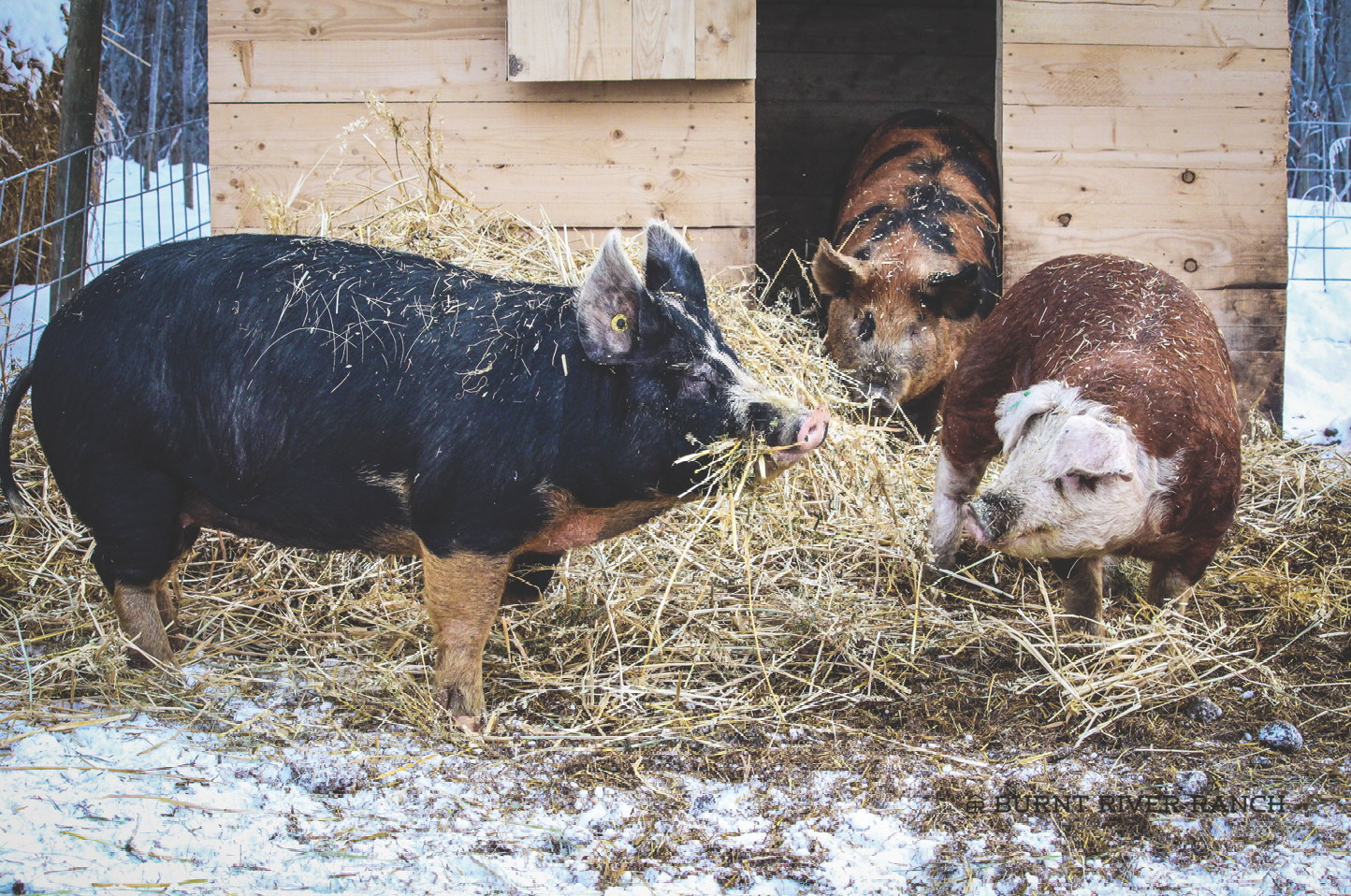
“Winter housing and summer housing is the same around here, shelter-wise,” she said of the herd of about 17-20 mature breeding hogs (Berkshire and Hereford with some other breeds like Large Blacks and Hampshire crosses.), and average about 250-plus piglets per year. “The only difference is the pigs we raise on pasture during the summer have a lot of access to densely forested areas and don’t really require a legitimate shelter. They are happy to curl up under a big spruce tree or make a burrow in the side of a hill.
Jacob said they like keeping things as simple as possible.
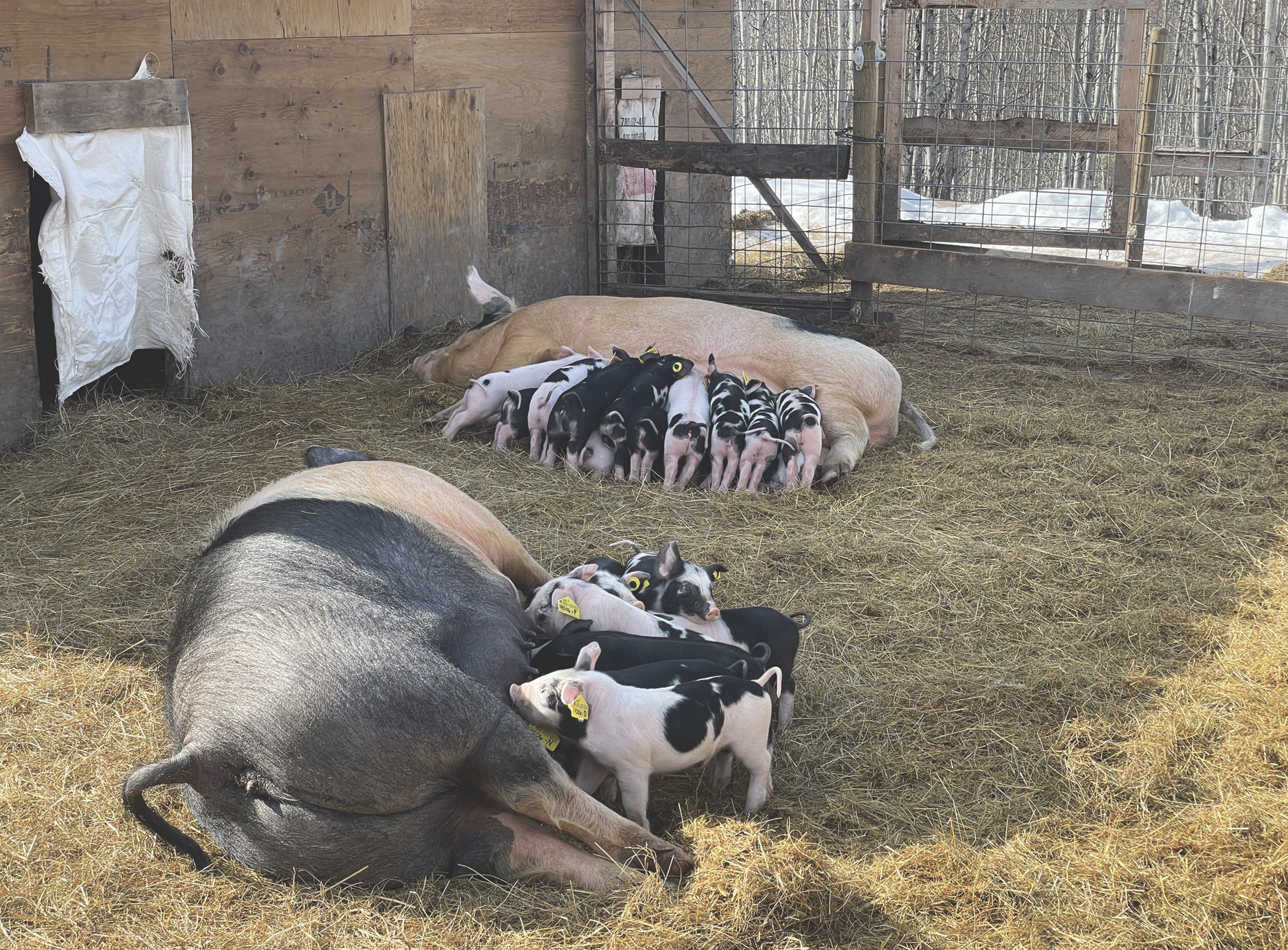
“Housing pigs in the winter has been fairly low maintenance,” she said. “We have always provided them with good three-sided shelters or more enclosed shelters with a door. Group housing allows them to cuddle up together and we also provide them with ample straw bedding. . .
“We keep our herd in smaller pens in groups for the winter for ease of watering and to be able to properly track breeding dates or heat cycles. From April-November our pigs are out on pasture.”
Jacob added, “When our temperatures are constantly dipping to -20 or colder, the pigs are not reaping any of the benefits of being out on pasture, and the snow tends to ground out the electric fences.”
One of the biggest challenge can be farrowing when it’s cold out.
“I’d say the biggest challenge of keeping pigs in a Canadian winter is probably farrowing out sows,” said Jacob. “People want a spring pig that is ready to butcher in the fall, as they fear wintering pigs, and unfortunately it is often the very coldest part of the year when we start having piglets, so it’s risky.
“However, if you are not farrowing pigs and are raising feeders over the winter, I think that’s a breeze. They stay clean, they can’t root out of their pens, and the heritage breeds that we raise are very hardy and well suited to a cold climate. Raising pigs intended for butcher can often be preferable in winter to summer, even.”
Davey said they manage to farrow in winter quite well.
“We have farrowed year around and have had babies in the winter, we try to put the sows into another pen, usually works out,” she said. “. . . We usually move the younger ones to a smaller pen with a cover so that we do not lose any to rollover.”
Stenhouse deals with cold farrowing by only farrowing once a year, and not in winter.
“One major thing, we breed and put the boar with our sows over the winter. Easier to feed and provide water when they are all together. We breed once a year. Duncan our boar gets evicted when we are getting ready to farrow in their shelter,” he said.
Robillard just avoids farrowing in the winter.
“Our Sows farrow in September and March,” he said. “Farrowing in winter as well as in the middle of the summer is just fighting the elements, useless and completely avoidable.”
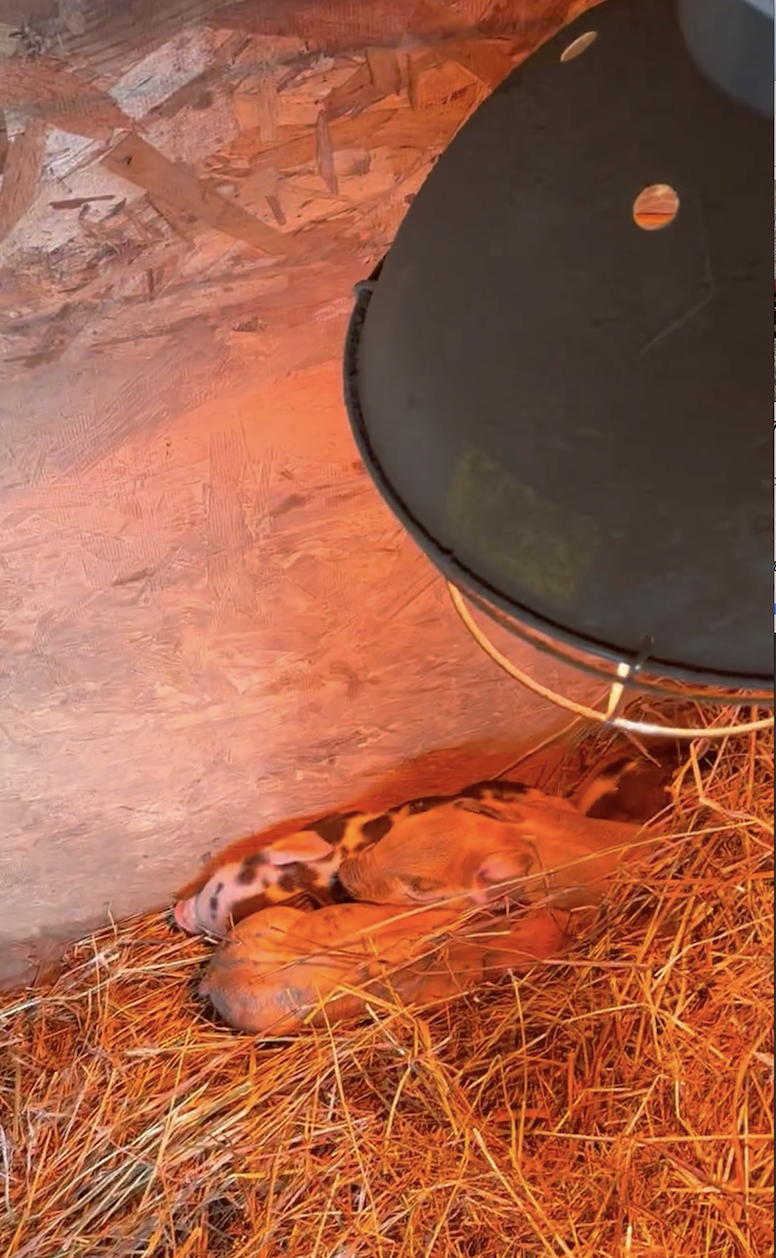
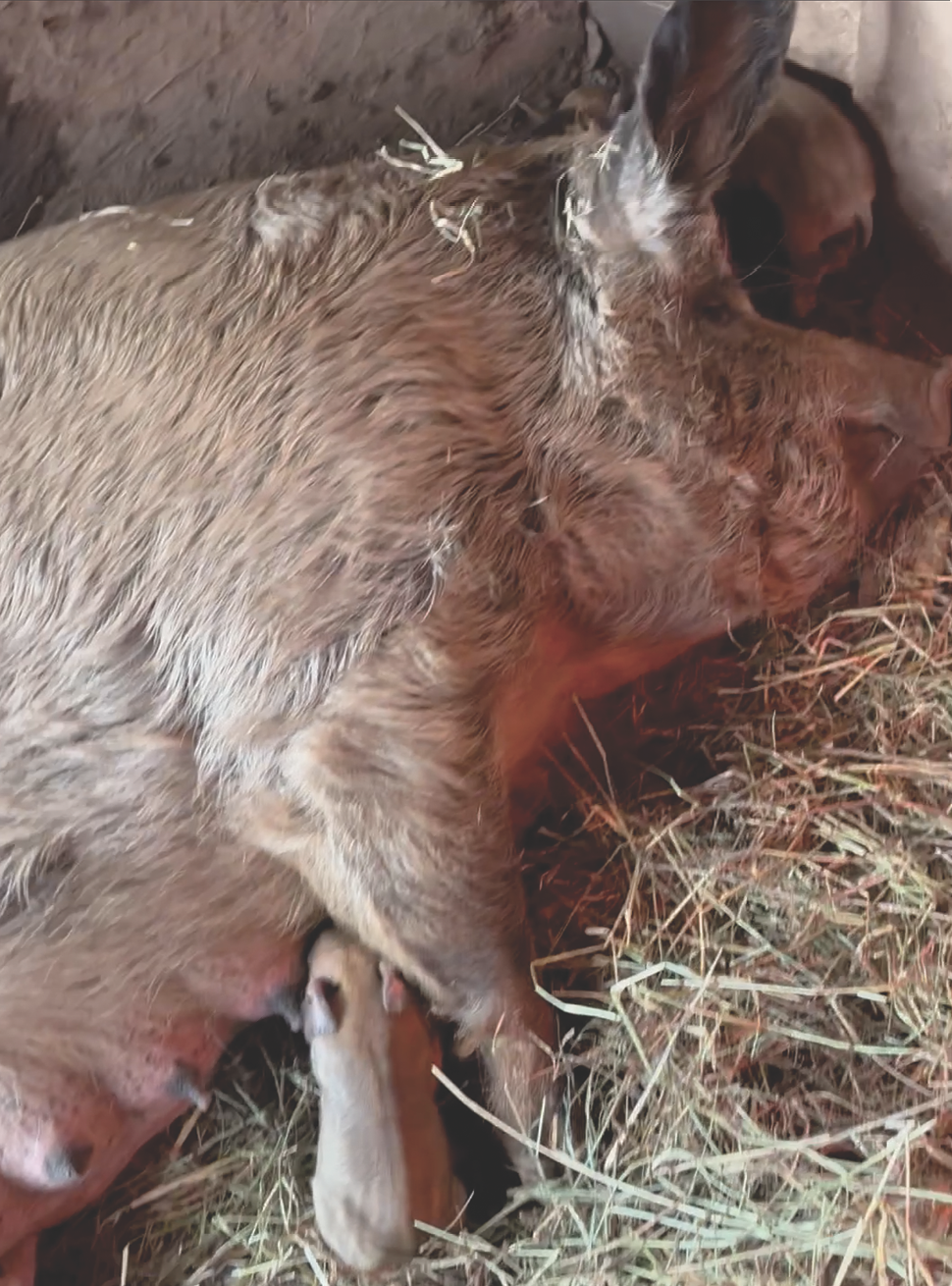
At Paul Beaton’s farm in Nova Scotia the pigs have access to five-acres year round of pasture.
But in winter he has added a building that he can use as needed building a 12 x 30 barn which can be used in summer as well.
The barn is part of the farrowing regime for Beaton where he has built a stall for each sow.
“I farrow in February usually,” he said
“I also use heat lamps with straw to keep piglets comfortable. One of the requirements for piglets is to be draft free. They can take cold no problem. This winter they were born at -17.
“I dried them off and put beside sow under a blanket. After feeding I put them under the heat lamp.
“They don’t take long to figure it out.”
Burnt River Ranching has evolved to farrowing indoors too.
“We start farrowing around early February and continue with farrowing groups until about April. Then we do another round in September-October,” said Jacob.
“The first few years, we used to farrow outside in insulated farrowing huts with crush rails and heat lamps but found it was just too hard to keep piglets alive in the cold temperatures.
“It also made it very hard for us to help sows or process piglets in a timely fashion. I know it works for some, but it wasn’t our experience.”
So a barn was added.
“We now have a fully insulated farrowing barn with farrowing crates. I know they are incredibly controversial, but it allows us to keep our piglets safe and warm and keep us safe too,” said Jacob. “We can now safely assist if a sow requires intervention, and we can give piglets their shots and get them castrated within the first few days of life. We keep good track of breeding dates so they only go in the barn about two days prior to their due date, and try our best to get sows and babies kicked out of the barn back into the big pens as soon as possible, usually within two weeks, so really, it’s a very small time-frame that the sows spend in there.
“Though the barn is not heated, it stays quite warm in there with sows inside. We also have cameras in the barn, so that we can always keep an eye on sows, even in the middle of the night.”
Feeding regimes tend to be tweaked in winter too, at least for some.
“As to their feeding we tend to keep an eye on the hog feeder and add or subtract feed as we see the need. . . In our winters there is no pasture to speak of, we try to get them hay to munch on,” offered Davey.
“Water is the biggest challenge in the winter since we need to lug water for the pigs.”
Jacob said they cut back on water somewhat.
“In the winter, we only give our pigs the amount of water they will actually drink so that they don’t waste it or muck around in it, and we switch to only watering once per day. Other than nursing sows that is, they get watered 2x/day,” she said.
However feeding stays much the same throughout the year.
“As for feeding, the pigs get the same amount of feed they normally get in the summertime, but if the weather drops below -20, then we feed them extra that day,” offered Jacob, adding “they also enjoy hay throughout the winter for enrichment and as an additional food source.”
Hay makes a winter appearance for Robillard too.
“The pigs have access to a hay bale at all times in winter and receive a ration of max four pounds a day,” he said, adding, “again; choosing the right breed is important. Managalitsa just doesn’t require any food adjustment in the winter. They are not suffering at all from the cold. They will play outside at minus-30 without hesitation. Surrounded by four inches of fat they are not using more energy in the winter to stay warm. . .
“Mature breeding animals are hardy and adapted to the system, but older sows and boars still receive extra bedding, shelter space, and careful monitoring of body condition through winter. to make sure they are optimal for breeding and farrowing. We have a very high success rate in our breeding because of the well-being of our pigs. We are talking of an average of 9-16 piglets per sow twice a year.”
Interestingly, Robillard suggested winters may be harder on the pastures pigs are kept in than on the pigs themselves.
“The biggest challenge is not for the pigs. It is for the land,” he said.
“You want to manage it so the land benefits from it instead of suffering from the presence of the pigs.
“When it’s really wet, you want them on deep bedding to protect them but also the structure of the soil.
“When it is windy you want them in the forest.
“When it is the sap season, you want them in the field. etc.
“You want to either move them often to manage manure distribution, or keep them on a deep bedding you can spread yourself later. No compromise possible.”
It’s a case of managing the pigs and pasture as a sort of symbiotic unit.
“Our pasture pigs remain outdoors year-round, including winter, with access to paddocks, brushy areas, and shelter rather than being confined to a fully indoor barn,” said Robillard. “Managing tree exposure is a sensible point. You want the pigs to be in the forest, but you don’t want them to destroy your trees. So in the Spring, when the sap goes up. You want them in a field and not in the trees or they will eat the bark.” •
— By Calvin Daniels