The clock is ticking on hog barns having to be reconfigured to provide group housing.
While July 2029 seems distant, in the world of renovating barns, it is two years away, according to experts at the Saskatchewan Pork Industry Symposium on Nov. 4-5 in Saskatoon.
Three speakers shed light on the conversion.
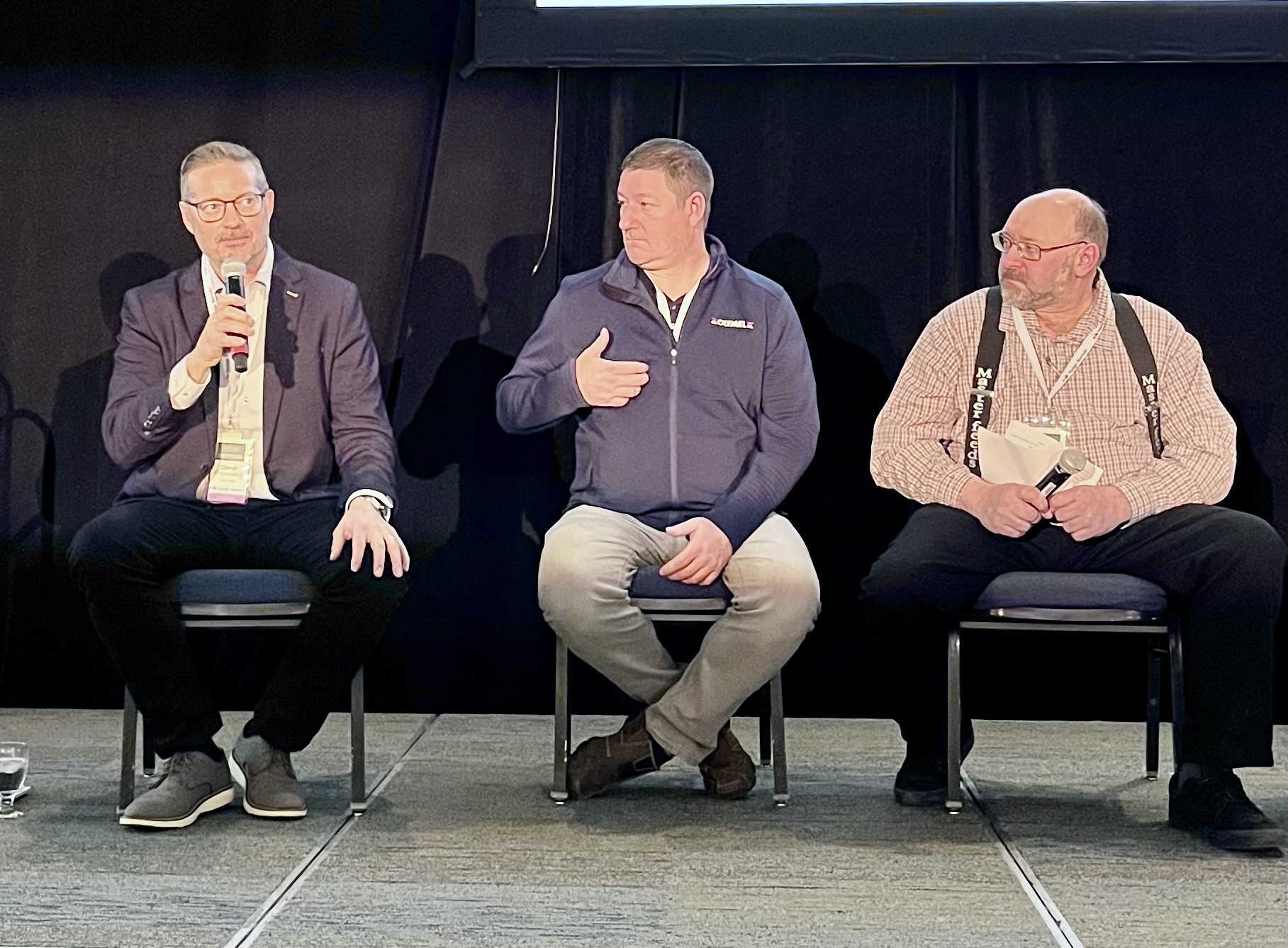
In the one-hour session, Toby Tschetter of the Star City Colony, Levi Soltys of Olymel, and Daryl Possberg of Polar Park Farms, took questions from moderator Ken Engele of the Prairie Swine Centre and from some of the 300 attendees at the symposium.
Levi Soltys is a production manager at Olymel, and is responsible for the safety of 100 employees, 13 facilities and production of 34,000 sows.
He was the first to take the microphone. He was asked what are things to consider when making the change to group housing.
“The first thing that comes to mind is cost. And what are your long-term plans? Are you doing this for a five-year period or a 20-year period?
“You know what you want out of pen gestation and work backwards from there, and build your farm accordingly.
“Maybe you can get away with doing a cheaper model or a cheaper style. So, there’s a 100 different options, you just have to find what suits you, your company and your business style.”
Tschetter was asked about his decision to step away from the industry. He said it came down to deciding if his colony wanted to stay in the industry.
“And we didn’t want to.”
He said he had a plan but couldn’t make it work.
“We couldn’t find the resources and requirements to help us, and we were getting to the point of staff availability.
“The barns got to the point where if we didn’t do some major renovations or maintenance, there was going to be some animal welfare issues. And we didn’t want to get into that situation.”
Tschetter was asked about the pros and cons of contract finishing.
“It’s definitely a less risky business problem.”
On the negative side, he said he is no long working for himself.
“Up until now, you’ve got your own barn; you’re making your own decisions; you’re doing your own thing. Now, contract finishing, you are working for someone else.”
Possberg — whose family has a 9,000-sow farm in Saskatchewan, and he is a partner in an Alberta-based 13,000 sow farrow-to-finish system — was asked what he would recommend to someone doing a renovation.
“We are far enough into this thing that there’s a whole bunch of people that have already done this.”
He said some of the people in the midst of the renovation were able to offer advice.
“There were guys who had converted, but not to the same level as we are now. There’s a lot of people in this room that have done this stuff.
“My recommendation is to talk to these people because in general they are very helpful. They want to see you succeed in this business.
“They will tell you how much stuff costs; they will let you go into their farms, and look at a lot of stuff in a lot of cases.”
Soltys says the transition to group housing has had its bumps along the way.
He said for staff there has been a long learning curve.
“For the sows, what we did when we converted was to reduce our inventory by about a third. We emptied one area of the barn, converted it and then moved sows over to that area.”
He said there was quite a bit of regression – tail biting and vulvitude.
“If I had to do it again, I would include enrichment, which was probably a miss.”
He said with a number of barns up to the new guidelines “we are getting better at it.”
They agreed open pen gestation is good for the sows and staff.
They were asked for their thoughts on the number of sows in a pen.
“We have anywhere from 60 to 360/380 and I haven’t seen any difference. The big pens do just as fine as the small pens.
“The only thing is the number of animals you are adding to the group. You don’t want to put just two or three animals in a group.
“Our system is dynamic, so we are steady, adding and taking animals out of that group. So, pen size didn’t matter to us, and I still don’t think it does.”
Possberg says he uses smaller pens.
“I have experience with 45 to 60, and 10 to 12 stuff. Honestly, if you are managing well, there was really no difference.”
What was the hardest part of the conversion?
“We made a decision that our barns were nearing the end of their best years,” Soltys said. They served their purpose, so they needed a complete refresh.
“We replaced the insulation, the wall coverings, and some of the pits got redone. But it takes forever; it’s a slow process. Waiting and working around the construction crews was a little bit challenging.”
Possberg said the hardest part was making the decision to do it. Once that decision was made it was go-time.
“Let’s look for opportunities to get this thing done; find a set of circumstances that can optimize this thing and go forward with it.” •
— By Cam Hutchinson
Staying Competitive in the Industry, Summary
Renovation Challenges
*Renovation process took longer and was more complex than planned.
*Unforeseen structural issues and immovable load-bearing walls required adaptation.
*Upgrading ventilation and service agreements was necessary due to increased requirements.
*Decision making to proceed with renovation was a significant challenge due to industry uncertainty.
Final Comments
*Industry urged to move forward together, emphasizing learning by doing and collaboration.
*Importance of considering total production losses and lost opportunities during sow conversion.
*Open pen gestation identified as a permanent change; recommended to revisit all business aspects (pen size, materials, genetics). •
— By Cam Hutchinson