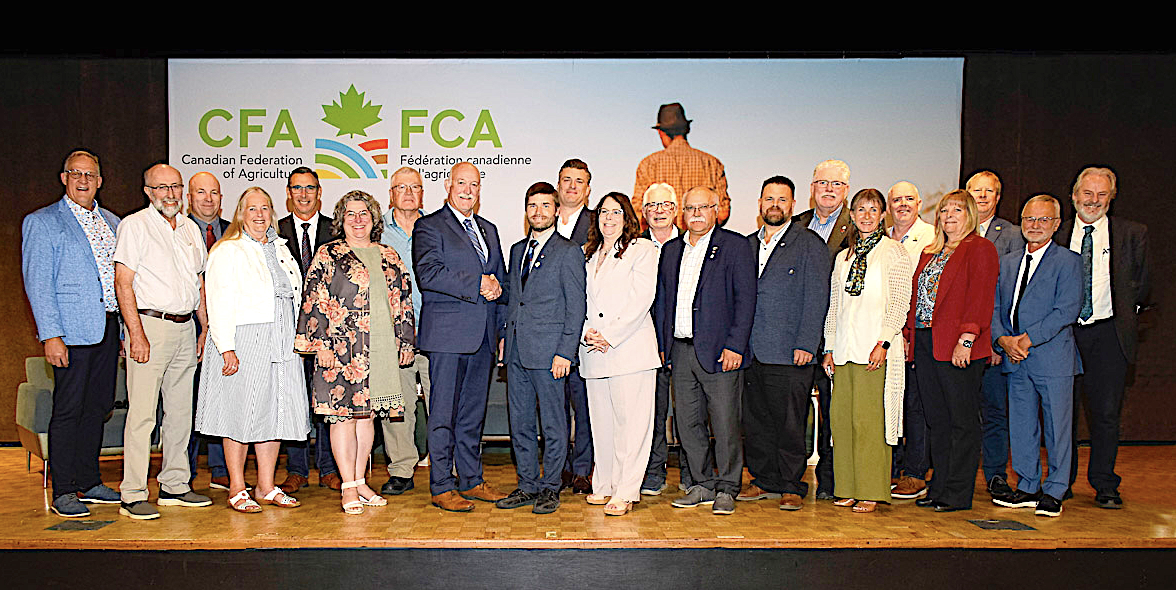
The Canadian Federation of Agriculture (CFA), representing over 190,000 Canadian farmers and farm families, has welcomed the Canadian Pork Council (CPC) as its newest member. This move reinforces unified advocacy on critical agricultural issues. The move signals a strategic shift to amplify agriculture’s voice – particularly on trade – and work more closely
Representing over 7,000 pork farms across nine provinces, the CPC plays a significant role in Canada’s agri-food sector. Pork production in Canada supports over 100,000 jobs, drives economic activity in rural communities, and contributes over $5 billion annually in global exports. With more than 70 percent of Canadian pork shipped abroad, CPC’s influence in shaping trade, sustainability, and animal health policies is both significant and far-reaching.
“We are so pleased to welcome the Canadian Pork Council as a member of the CFA,” said Keith Currie, President of the Canadian Federation of Agriculture. “As Canada’s largest general farm organization, CFA brings farm leaders from across the provinces, territories, and a diverse mix of commodity groups to drive Canadian agriculture forward by fostering a strong and united voice. With CPC at the table, our national voice grows even stronger, particularly when engaging with the federal government on complex issues like sustainability, labour, animal health, emergency preparedness, trade, and competitiveness. Our industry must work together to advance common solutions, and this announcement takes us one step further.”
CFA and CPC have a long-standing history of cooperation on mutual concerns. With this formal membership, that collaboration becomes more structured and impactful, particularly in national policy discussions and when addressing the growing number of regulatory challenges and trade pressures facing Canadian producers.
René Roy, Chair of the Canadian Pork Council, said joining CFA builds on their shared vision for a collaborative future. “As a national organization representing pork producers from nine provinces, it’s important for us to be part of a collective voice that speaks for Canadian agriculture as a whole,” Roy said. “We believe in the value of unity across sectors and see this membership as an opportunity to strengthen collaboration and ensure pork producers are well represented on the national stage. Trade is vital to the success of Canadian agriculture, and by working together through the CFA, we can better advocate for strong trade frameworks that support farmers and rural communities across the country.”
The announcement also drew praise from Manitoba Pork, which supports more than 600 pork producers in the province and is a member of the Canadian Pork Council. “This is a welcome step forward,” said Cam Dahl, General Manager of Manitoba Pork. “Canada’s agriculture sector thrives when we work together. The pork industry in Manitoba makes a significant contribution to our provincial economy and plays a crucial role in ensuring food security and facilitating international trade. Having the CPC now formally involved with the CFA will help ensure pork producers’ perspectives are part of the broader agricultural conversation, particularly when it comes to policy and program development.”
Roy, said the decision came after several discussions at the board level to rejoin the CFA.
“We wanted a stronger voice in agriculture,” Roy said. “People should not see trade as a side issue – it’s a core component of Canadian agriculture. That’s why we felt it was important to rejoin CFA and ensure our producers get representation at the national decision-making level.” Roy emphasized that CPC had collaborated with CFA on many policy areas even before becoming a member again.
“It’s not like we were strangers,” he said. “We worked together on important topics like farm transition planning and the business risk management (BRM) suite of programs. But by becoming members, we now have a seat at the table. We’re helping shape the direction, not just responding to it.”
That distinction matters. Roy said the CPC wants to ensure its members’ interests get fully represented – especially now, as the sector faces serious trade threats and shifting global dynamics.
As someone who has covered the pork industry for more than 50 years, I’ve seen how fragmented voices can slow down or weaken real progress. Farmers require consistent and unified leadership – especially when negotiating with governments or international trade partners.
“We’ve seen the damage caused by division,” Roy said. “When agriculture gets split – between supply-managed sectors and trade-oriented ones – we lose impact. Canada can’t afford that. Our food producers need to stand together and speak with one voice.”
Roy pointed to upcoming U.S. tariffs, which are scheduled to take effect August 1 and could be as high as 35 percent. While the Canada-U.S.-Mexico Agreement (CUSMA) currently protects Canadian pork from some of these tariffs, the broader threat still creates deep uncertainty for farmers and processors.
“We can’t afford to have our food supply chain disrupted,” Roy said. “Our producers rely on steady, rules-based trade. These tariff threats remind us how fragile that can be.”
He also highlighted the need for stronger collaboration not just within Canada, but across North America.
“We’re working with our U.S. counterparts to present a stronger voice on both sides of the border,” Roy said.
“But we also need to know our government in Ottawa is with us – backing Canadian pork and agriculture as a whole,” Roy added.
Roy believes Canada’s pork producers can grow and innovate – but only if governments partner with them rather than create barriers.
“We have tremendous opportunities,” he said. “But we need the federal government’s willingness to work with us, to develop and support strategies that move Canadian agriculture forward.”
As we move deeper into 2025, this move by CPC to rejoin CFA may help chart a more unified, results – driven course for agriculture. While many sectors in Canadian farming face different pressures, their need for strong representation and clear advocacy is the same.
And that starts with one thing: working together.
“Agriculture is too important to be divided,” Roy said. “It’s time we speak clearly and with one voice – for our producers, for our food systems, and Canada.”
This strengthened alliance between CPC and CFA comes at a pivotal time. Producers face increasing pressure from rising input costs, shifting global trade dynamics, and evolving regulatory landscapes. The unified representation provides a more coordinated approach to addressing cross-sector challenges, ranging from climate resilience and innovation to market access and labour shortages.
As the agri-food sector looks toward the future, collaboration remains essential. The CFA reiterated its ongoing commitment to building a resilient, competitive, and sustainable agricultural landscape. Welcoming the Canadian Pork Council further strengthens that mission – creating a more connected network of commodity and general farm organizations prepared to face current and future challenges together.
With this move, the CFA continues to grow as a powerful and inclusive voice for Canadian farmers, bringing even more perspectives to the table and ensuring all producers have a say in the national dialogue that shapes the industry. •
— By Harry Siemens