

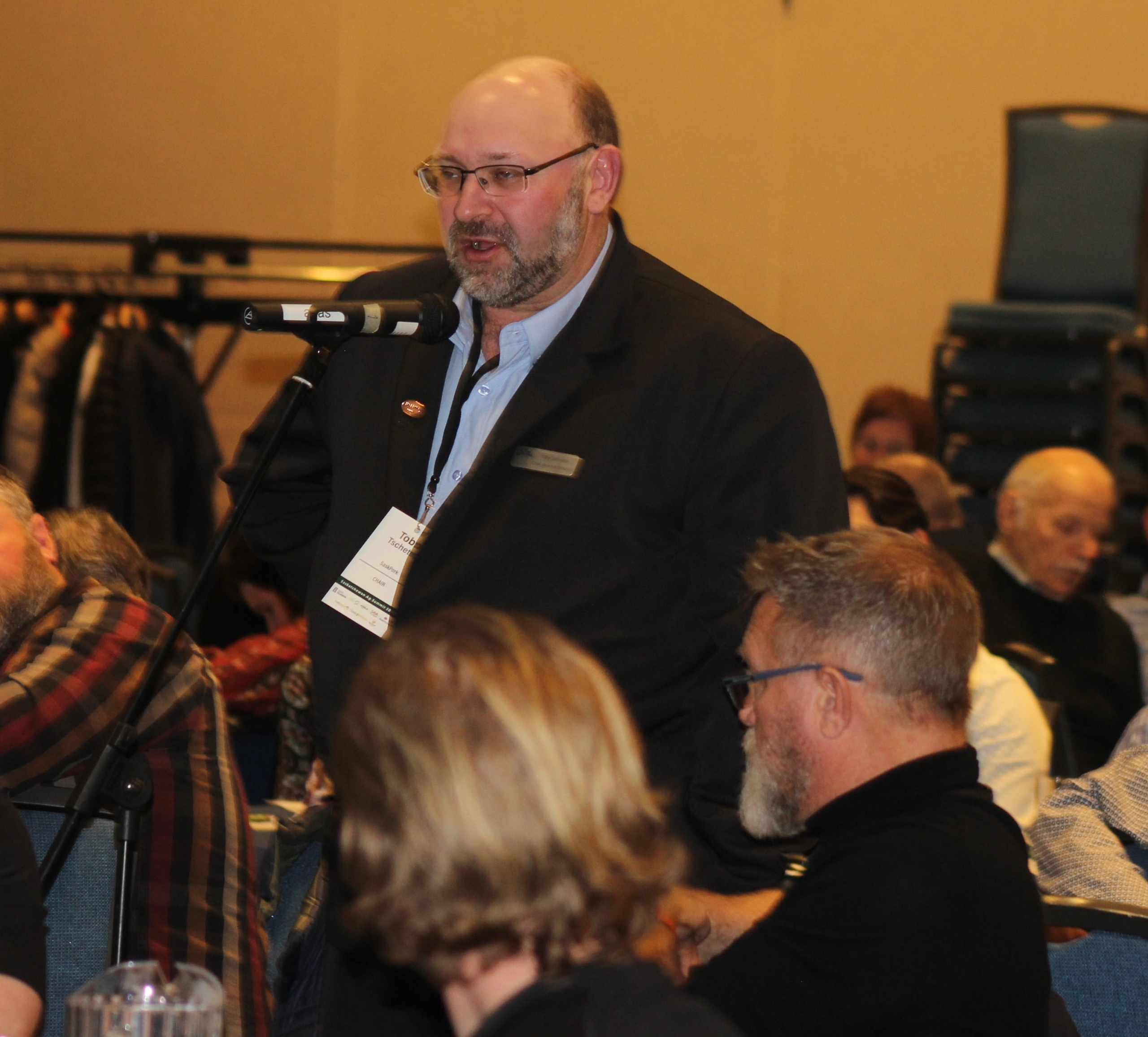
Toby Tschetter liked what he heard at Saskatchewan Ag Summit 2025. He also liked rubbing shoulders with folks in other areas of the industry.
“This is the perfect opportunity for other groups to get their message out to groups outside of their own. It is very inspiring to see the whole ag industry get together in one room,” Tschetter, chair of Sask Pork, said in an interview.
“It goes to show how inter-related our industry is – getting together with other groups and everybody here realizing they have to move their business forward.”
The summit – held on March 27 in Saskatoon, and hosted by the Agriculture Producers Association of Saskatchewan (APAS) — featured speakers from various parts of the country.
The speakers shared their expertise in a broad range of topics, with trade being the most common. The name Trump came up a few times.
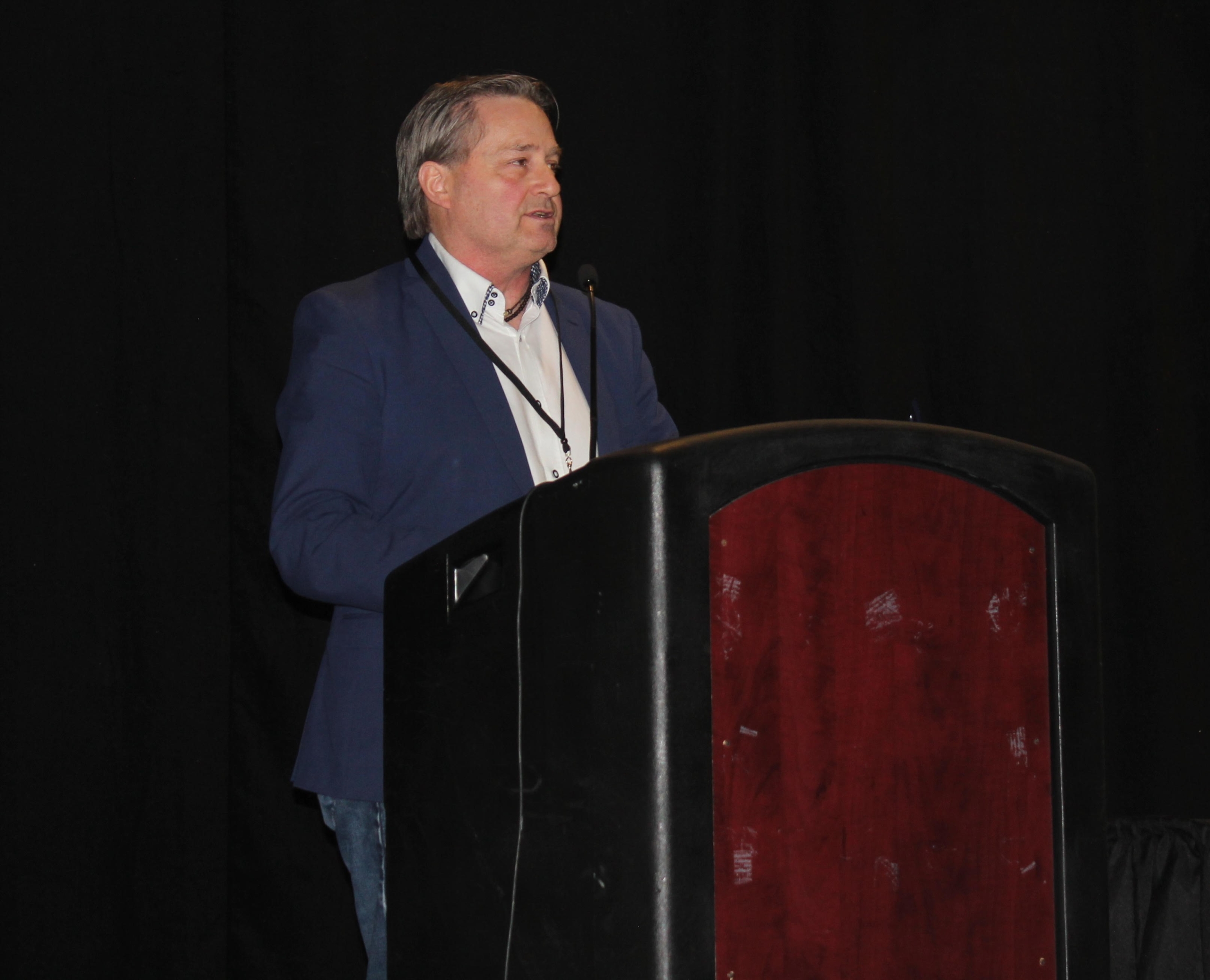
Chris Dekker – CEO, Saskatchewan Trade and Export Partnership (STEP) – titled his presentation Trade, Trump and Tariffs – What’s Next?
Carlo Dade — director for International Policy, University of Calgary – referred to the United States as a mobster trying to shake others down, drawing chuckles from those in the packed convention room at the Saskatoon Inn.
Dade, who appeared on video, was asked questions by Jeremy Welter, vice-president of APAS.
In his first question, Welter said he would like to accentuate the positives that could come out of the situation those in the ag world are facing.
Dade said there is a global demand for food of all commodities.
“Demand and the estimates of demand have not shifted … what has changed obviously is the global trade situation, and there is no way to sugarcoat what is happening in the U.S. This is the existential threat of our generation in Canada, with not the closing of the U.S. market, but the damage the Americans are deliberately inflicting … and the inadvertent damage of the incompetence of what they are doing are existential threats to us.”
He said there are struggles beyond the U.S., pointing to Japan and Europe – “anyone trying to sell durum wheat can well understand the issues we have on that front.
“We are facing trade negotiations with India, which will be a generation struggle to be able to engage India in a more predictable and educational manner.
“So, the opportunities exist in baseline. Where we need to apply our energies is not market access so much, but quality of access. We need predictability; we need certainty.”
Dade said work has to be done to determine if there is hope or more reasons to worry.
He said a group in the ag policy community is looking at global trade policy. Dade said they are starting with a clean slate.
“I think there are many of us who are starting to turn our minds away from the past and try to figure out what is going to work in the future. We are not talking tweaks here; it’s out-of-the-box thinking for what we can do in the new world we find ourselves in.”
Welter asked Dade if policy organizations and lobby groups should be pushing provinces to deal with the federal government to come up with a comprehensive national strategy to improve our export infrastructure.
“The provinces have been good, and hats off to Saskatchewan for joining the other Prairie provinces on getting this work started on the prairies.
“We need a larger plan. When I go to Ottawa … and especially when I am talking to MPs, the response I get is, “yeah, we understand it’s a problem, but we have 30 other things that are a problem and with the 30 things, we have 25 groups yelling and screaming at us when we go home for the summer barbecue circuit … we hear about these issues. No one is talking about trade issues unless you show up at my barbecue because someone forgot to stop you at the front gate.”
“They just aren’t hearing it from the grassroots. You’ve heard Pierre Poilievre; he doesn’t want hear from pinheads like me telling him what needs to be done. He doesn’t want to hear business councils and their lobbies telling him what needs to be done. If he doesn’t hear it from the grassroots when he is door knocking, it’s not going to be an issue.”
He said there are encouraging things in these uncertain times.
“Folks who don’t produce goods for a living, don’t ship or transport goods for a living have had it driven home to them, how important this is. Diversification from U.S. goods is a window of opportunity.
“Americans are going to cut subsidies to (their) farmers. Is that an opportunity or a threat to us? There are no easy answers. Anyone who has an easy or simple answer is lying to you.
“The Americans are now trying to bury the World Trade Organization, not save it. You don’t have the easy world you had in the past. Looking at what’s coming, it is going to be incumbent on all of us to step up our investments in the ability to survive.”
Dade said there is work to be done but he is optimistic.
“There are no easy answers; no simple solutions. I see opportunities. We haven’t given up the fight yet, but it’s going to be harder; it’s going to require more effort; it is going to require more resources. We can give up or stand up and fight.
“That’s the question we are facing as a nation.”
Dekker got the attention of the audience when “WTF” appeared on the screen.
“Doesn’t that sum it up? How did we get from the world’s largest free trade block to fighting for our economic lives in about six months?”
He reminded those in attendance that Saskatchewan is a tiny domestic market with a population of about 1,250,000 people, but is rich in resources to export.
“So, we have to sell the vast array of products and services that we manufacture or we extract. We are one of most trade-dependent provinces in one of the most trade-dependant countries in the world.”
In his explanation of what STEP does, he said one thing it does is provide risk reduction business for exporters.
“Market access is No. 1 (in the STEP world). That has changed with one thing,” he said, pointing at a photo of Donald Trump.
Dekker said it is difficult to track tariffs, given Trump’s constant change in them.
“The uncertainty is almost as bad as the tariffs themselves. It is tough to manage when you don’t know.
“What is government doing and how are we helping government?” he asked, pointing out “we are aligned very closely with our provincial government.
“There is a fight going on and it’s two-fold. There is the lobby; you hear about our representatives going to Washington and meeting with various states to promote the benefits of free trade and making sure they understand the disadvantages of protectionism.
“There is also a legal battle going on. What Donald is doing is not legal,” Dekker said, pointing to various trade deals.
He said the legal battles in both the U.S. and Canada will go nowhere or, if they do, will take years to settle.
“We are also going to diversify,” he said. “This is something the provincial government has been encouraging everyone to do over many years, and something STEP has been doing for 30 years.”
He said 55 per cent of what we ship around the world goes to the United States. He pointed out that Saskatchewan is already the most diversified province in Canada. Ontario and Quebec are more like 80-85 per cent, he said.
“We are still looking for other markets around the world … but this takes years to develop,” he said.
“We are not giving up on the United States. We have 23 U.S. missions planned for this fiscal year … We are not going unarmed.”
Using a document called Trading Places to dispel myths about the trade situation in the province and country, STEP has found “95 per cent of the people who come to our booth in the four or five (missions) we have been to in this fiscal year are supportive; they are embarrassed.”
He said STEP recently did a survey of its members.
“We asked what are your businesses doing in advance of U.S. tariffs? The first observation is that exporters are not sure what to do; this is very unique for them.
“Most said they would be seeking alternative markets and were accelerating shipments to the U.S. and they’re doing that in spades.
“We have one member who has 85 rail cars across the border in the United States with his product to fill orders and avoid any tariffs.”
He pointed to companies, such as those in the potash business, doing the same thing.
“That will work for a limited amount of time.”
Members were asked if tariffs were imposed what would they do?
“Again, many said they don’t know, but for those who supplied an answer, they said they would negotiate with their U.S. customers to share the burden of the tariff.”
If it’s at 25 per cent, the two companies could cut it down the middle.
“It depends on the domestic substitution in the United States. If they have options that is where they are going to go. If there are some options, but they like your product, they might split it 12.5 – 12.5. If they have no options, you could pass that price along, in theory.”
He said business-to-business has a little more emphasis than government-to-government because the message is being heard by the grassroots in both countries.
He said states and provinces have banded together to ensure they understand the benefit of doing business with each other.
“Believe me, we have allies in the United States. Chambers from Montana to Oregon to Washington to Alaska are totally upset and are against it.”
Tschetter likes the idea of businesses working together.
“It seems business-to-business is a strategy that could work. I can (also) see province-state relationships being very beneficial too.”
Tschetter said Saskatchewan pork producers are in a unique situation when it comes to tariffs “because one of the aspects of our industry it is going to affect is live pork shipments into the United States.
“In Saskatchewan, that is kind of a one-way street. There is no live pork coming back in, so this one aspect of industry is going to be affected very much – live pork going into the United States.”
He said hog producers could also pay more for feed coming into Canada.
“We depend on the U.S. for a lot of our soy bean meal that goes into swine nutrition.”
Tariffs or not, he stands by Canada’s products.
“We supply good products from this country, so we could be viewed as a very sustainable food source for the world, and we just have to keep maintaining our relationships.” •
— By Cam Hutchinson